


If you’re trying to create a GCSE revision timetable that actually works for a busy family (without taking over every evening), you’re in the right place. You don’t need a military-style wall chart – you need a simple plan that fits around work, clubs, siblings and real life, so your teen can revise consistently, build confidence and still have downtime.
What we’ll cover (in plain English)
- Why most GCSE revision timetables fall apart.
- How to build a weekly structure that fits real family life.
- How long revision blocks should be (and how many you really need).
- A simple way to balance subjects without overwhelm.
- How parents can support the timetable (without becoming the “revision police”).
By the end, you’ll have a realistic GCSE revision timetable template you can start this week, plus ideas for when it might be time to bring in extra support like Level-Up Online Tutoring.

A realistic GCSE revision timetable works with your teen’s life, not against it.
Why Most GCSE Revision Timetables Fail
Lots of teens start with a beautiful colour-coded timetable that lasts about three days. Common problems:
- Too rigid – no room for tired days, clubs or family plans.
- Too intense – long blocks that feel overwhelming.
- Not teen-led – it’s done “to” them, so there’s no ownership.
- Ignores energy levels – some work better earlier or later in the day.
The aim isn’t perfection. It’s a timetable your teen can stick to most of the time that reduces stress instead of adding to it. Our guide on how parents can support GCSE revision at home pairs really well with this article.
Step 1: Start with Their Real Week
Before subjects, look at how the week actually runs:
- Note fixed commitments: school, clubs, part-time work, travel, family events.
- Mark tired days: “Wednesday is football, so not a big revision night.”
- Protect wind-down time: dinner, TV, shower, phone, etc.
This shows you’re not taking away their whole life and reveals the realistic pockets you can turn into revision blocks.
Step 2: Choose 3–5 Core Revision Windows
Rather than “revise every night”, pick 3–5 windows where revision is most likely to happen:
- Sunday late morning for a calm 60–90 minute session.
- One or two early evenings with no clubs.
- One shorter after-school slot for flashcards or lighter work.
For many busy families, a simple GCSE revision timetable might look like:
- Sunday: 11.00–12.30 – Weekly reset + revision.
- Tuesday: 5.00–5.45 – Quick topic review.
- Thursday: 6.00–6.45 – Past paper questions.
- Saturday: 10.30–11.15 – Flashcards / light revision.
That’s already 3–4 hours of focused revision a week without touching every evening.
Step 3: Use Short, Clear Blocks
Once you’ve chosen the windows, break each one into 20–30 minute chunks with a clear job:
- Chunk 1: Learn / revise a topic.
- Chunk 2: Practise exam-style questions.
- Chunk 3: Quick review / flashcards.
Example 60-minute Sunday session:
- 20 mins – Revise “Algebraic fractions” (notes + video).
- 20 mins – Answer 5 exam questions.
- 20 mins – Mark, spot mistakes, update flashcards.
Teens are more likely to start a 20-minute chunk than a vague “Do some Maths”.

Plan short, focused blocks together – it feels lighter, but works harder.
Step 4: Balance Subjects with the 3:2:1 Rule
To fit all the subjects into your GCSE revision timetable, try the 3:2:1 rule each week:
- 3 focus subjects – English, Maths and one science, or any weaker subjects.
- 2 supporting subjects – e.g. Geography, History, a language.
- 1 lighter subject – a subject they enjoy or feel confident in.
Rotate the 3 focus subjects through the main revision windows, sprinkle in the supporting subjects and occasionally finish with the lighter one to build confidence.
Step 5: Protect Rest and Reduce Stress
Rest, sleep and movement are part of revision – not a luxury. When you design the timetable:
- Block out at least one revision-free evening each week.
- Make space for a short walk or movement most days.
- Encourage a reasonable bedtime – late-night scrolling undoes a lot of work.
The NHS has a useful guide on helping your child beat exam stress if anxiety is already high.
Sample GCSE Revision Timetable for a Busy Week
Here’s an example of a simple GCSE revision timetable for a Year 11 in a busy household:
- Monday – No formal revision (late club + tired).
- Tuesday – 5.00–5.40pm: English Language (20 mins skills, 20 mins exam questions).
- Wednesday – Light evening only (family time / TV / rest).
- Thursday – 6.00–6.45pm: Maths (20 mins topic, 25 mins practice questions).
- Saturday – 10.30–11.15am: Combined Science (20 mins revise, 20 mins questions, quick review).
- Sunday – 11.00–12.30pm: Weekly reset – plan the week, flashcards, catch-up.
That’s roughly four hours of intentional, focused revision without sacrificing every evening or weekend.
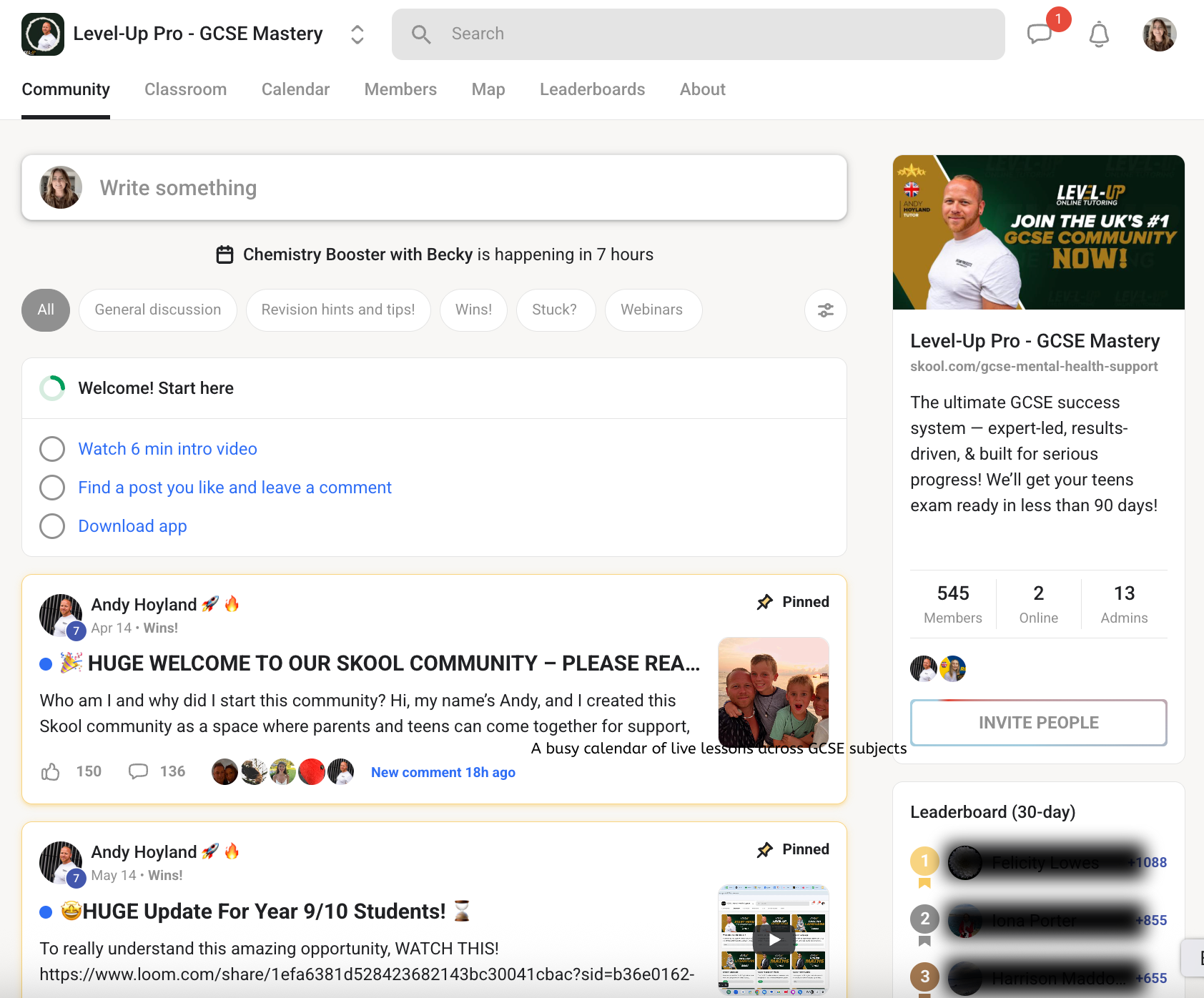
Structure, community and teacher support help teens stick to their GCSE revision timetable.
How Parents Can Support (Without Nagging)
Your role isn’t to stand over them with a stopwatch. It’s to keep the GCSE revision timetable doable and calm:
- Agree the plan together – ask, “What feels realistic to you?”
- Use gentle prompts – “It’s nearly five, did you still want to do that quick Maths session?”
- Offer practical help – quiet space, snack, printing past papers, setting timers.
- Celebrate effort, not just grades – “I’m proud you did that 30-minute block even though you were tired.”
Even with good routines and timetables, GCSE content can feel very different from what we studied at school — and life is busy. That doesn’t mean you’re failing them; it might just be time for some extra support so they feel guided, not alone. If you’d like to see how other families are finding the programme, you can read our 5-star reviews here.
Why Level-Up Makes GCSE Revision Timetables Work Better
If you want your teen to get more out of the time they’re already revising, the Level-Up programme is built for exactly that. Students get:
- Live lessons and replays they can watch in short, focused bursts.
- Clear, step-by-step guidance on how to revise each subject.
- On-tap help in the community when they’re stuck, so they don’t lose momentum.
✅ Ready for a GCSE revision timetable that actually sticks (without taking over home life)?
Bottom Line
The best GCSE revision timetable isn’t the fanciest or the most intense. It’s the one your teen can actually follow most of the time, in the middle of your busy family life. Start small, protect rest and focus on consistent, bite-sized sessions. You don’t have to do this alone.
Mind reading: How much GCSE revision per day?
Also helpful: How parents can support GCSE revision at home