


If GCSEs are getting closer and you’re thinking, “We need a clear GCSE revision plan for the last few months – and fast”, you’re not alone. Most parents aren’t short on effort or worry; they’re short on a simple, realistic plan that their teen will actually follow. This guide is here to help you create a calm, doable GCSE revision plan for the last few months before exams – one that supports progress and protects your child’s mental health.
Why the last few months feel so intense (and why it’s not too late)
The final stretch before GCSEs can feel like all the pressure has suddenly been turned up:
- Mocks have either just happened or are on the horizon.
- Teachers are talking about “crunch time” and predicted grades.
- Your teen is more aware of what’s riding on these exams – and may be stressed, avoidant or both.
The good news? The last few months are exactly when a clear GCSE revision plan makes the biggest difference. You don’t need a perfect year-long strategy. You just need something simple enough to stick to, and focused enough to move the needle.

A clear GCSE revision plan for the last few months doesn’t have to be complicated – it just has to be realistic.
A simple GCSE revision plan for the last few months
Think of your GCSE revision plan like scaffolding: it supports your teen, but doesn’t smother them. Here’s a simple way to build it.
1. Start with where they are now
Before you plan anything, get a rough picture of their starting point:
- Which subjects feel strongest, and which feel shaky?
- Are there obvious gaps from mocks, quizzes or homework?
- How many evenings / weekend slots are realistically available each week?
This doesn’t need a colour-coded spreadsheet. A piece of paper and an honest chat is enough.
2. Choose 2–3 focus subjects (for now)
Trying to “fix everything” at once usually ends in overwhelm. Instead:
- Pick 2–3 key subjects to prioritise for the next 2–3 weeks.
- Within those, note specific topics that need attention (e.g. “Algebra”, “Macbeth quotes”, “Cell biology”).
You can rotate focus subjects as you go. The aim is targeted effort, not spreading them too thin.
3. Build a realistic weekly skeleton
Now sketch a simple GCSE revision plan for the last few months that fits around real life:
- Look at clubs, work shifts, family commitments and downtime.
- Block out 3–5 revision slots per week – even 25–30 minutes each makes a big difference.
- Assign each slot a subject and a rough focus (e.g. “Maths – algebra practice”, “English – key quotes”).
It’s better to have a modest plan you actually stick to than an ambitious one that falls apart by Wednesday.
4. Use short, focused revision blocks
Instead of “Revise all evening”, aim for:
- 25–30 minutes of focused revision on one subject or topic.
- 5–10 minutes’ break (stretch, snack, phone check).
In each block, your teen should be doing something active, not just reading:
- Answering questions from a workbook or resource.
- Testing themselves on key facts or quotes.
- Summarising a topic in their own words.
- Re-watching a specific teaching video and then writing down what they’ve understood.
5. Include “maintain, don’t forget” time
As you get closer to exams, it’s not just about learning new things – it’s about not losing what they already know. Once a week, add a lighter slot for:
- Quick-fire quizzes on earlier topics.
- Revisiting tricky lessons from a few weeks ago.
- Checking they can still remember key formulas or quotes.
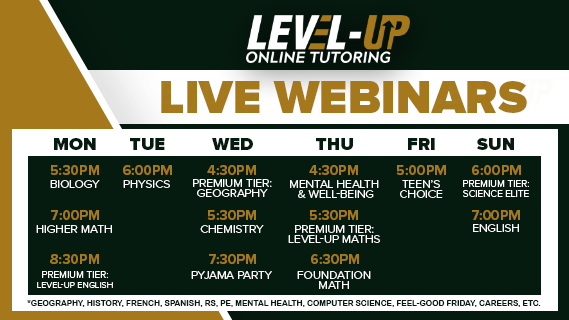
Having a simple structure – whether at home or through Level-Up – stops GCSE revision feeling like a constant guessing game.
What a realistic GCSE week could look like
Here’s an example of a GCSE revision plan for the last few months that feels achievable for many families:
- Monday: 25 minutes Maths (target topic) after dinner.
- Wednesday: 25 minutes Science (one unit) + 10-minute recap.
- Thursday: Level-Up live class or replay in a key subject.
- Saturday: 2 x 25-minute blocks (e.g. English + a weaker subject), with a proper break in between.
- Sunday: 20-minute “maintain” session – quick review of what they’ve covered this week.
This is just a template. Some weeks will be lighter or heavier; some days won’t go to plan. That’s normal. What matters is that, over time, revision becomes consistent, not chaotic.
If you’d like more ideas for keeping this manageable without turning into the “exam police”, you might also like: How to help with GCSE revision without nagging, backing off or taking over.
Your role as a parent: support, not supervisor
You don’t have to stand over your teen with a stopwatch. In fact, they’re more likely to stick to a GCSE revision plan for the last few months if you:
- Agree the plan together instead of imposing it.
- Ask curious questions like “What are your two focus subjects this week?” rather than “Have you revised?”
- Notice effort – “I saw you stuck with that even when it was hard – that’s brilliant.”
- Keep the tone calm so home feels like a safe base, not an extension of school pressure.
And if you’re worried about their stress levels, you might find this helpful alongside your plan: How to reduce GCSE stress and anxiety for teens.
When a home plan isn’t enough on its own
Sometimes, even with a decent plan, you can feel:
- Out of your depth with the content.
- Tired of being the only one pushing things along.
- Worried that gaps are still slipping through the net.
That doesn’t mean you’ve failed. It just means your teen might need more expert input and accountability than you can reasonably provide on your own – and that’s exactly where Level-Up comes in.
Want to see how Level-Up works before you decide?
Andy runs a friendly 20–30 minute Welcome Session every Tuesday at 7pm (UK time) for new and curious parents and students. You’ll see how to find the right lessons quickly, how live lessons and replays work, and how the community supports your teen day to day.
Reserve your place for the next Tuesday session
You don’t need to be a member to join – it’s a chance to explore the platform and ask questions before you commit.

With Level-Up, your child gets a ready-made GCSE revision plan for the last few months – plus teachers and a community to walk it with them.
How Level-Up gives your teen a ready-made revision plan
Level-Up is an education platform trusted by hundreds of UK families to help teens reduce GCSE stress, improve their grades and feel genuinely more confident about exams. It’s designed to give your child structure, not just more stuff to do.
Inside the Level-Up GCSE Support Community, your teen gets:
- 32+ live classes a month across the core GCSE subjects, so there’s always something relevant to join.
- Daily access to 15+ expert teachers inside the community for “I’m stuck” questions and quick help.
- On-demand lessons and pre-recorded modules so they can revisit tricky topics whenever they need to.
- Weekly mental health and teen hangout sessions to talk about stress, motivation and confidence in a safe space.
- A friendly community of 500+ UK students so they realise they’re not the only one finding this hard.
In other words, Level-Up acts like a structured GCSE revision plan for the last few months – built and delivered by experienced teachers – so you don’t have to hold everything together by yourself at home.
If you’d like to see how other families have found it, you can read our 5-star reviews here.
✅ Want a GCSE revision plan for the last few months that doesn’t take over family life?
Bottom line: a simple plan beats a perfect one
You don’t need an expert-level spreadsheet to create a strong GCSE revision plan for the last few months. You need a clear starting point, a handful of focused slots each week, and a system that helps your teen actually use those slots well. With a calm home routine and support from a programme like Level-Up, your child can still make meaningful progress – without GCSEs swallowing everything.
Mind reading: GCSEs are in 5 months and my child hasn’t started revising – how can we help?
Also helpful: What actually matters right now for GCSE success?