


If your child is starting Year 10, you may suddenly feel as though GCSEs have become very real. New subjects, new expectations, mocks on the horizon and talk of grades can make parents wonder whether they should already be pushing revision harder.
The good news is that Year 10 does not need to begin with pressure. In fact, one of the best things you can do now is help your child build the habits, confidence and support that will make the whole GCSE journey feel more manageable later.
Year 10 is not the time to panic about GCSEs.
It is the time to build the routines that stop panic becoming necessary later.
Want to give your Year 10 child a stronger GCSE start?
Level-Up gives students regular GCSE teaching, short tutorials and support when they get stuck, helping them build confidence before Year 11 pressure begins.
What changes when your child starts Year 10?
For many students, Year 10 is the point where school starts to feel different.
Topics become more detailed, teachers begin talking more seriously about GCSE requirements, and students may start noticing which subjects feel comfortable and which ones do not.
Some students take this in their stride. Others begin quietly accumulating gaps without anyone realising.
You might start hearing:
- “I don’t understand what we’re doing in Maths.”
- “I’m terrible at Science.”
- “I don’t know how to revise.”
- “I’ll worry about it in Year 11.”
- “There’s loads of time before the exams.”
None of those comments need to cause alarm. But they are useful clues about where a little support now could prevent bigger stress later.
Helpful reframe: Year 10 is not about preparing for an exam tomorrow. It is about making sure your child does not arrive in Year 11 carrying a year’s worth of confusion with them.
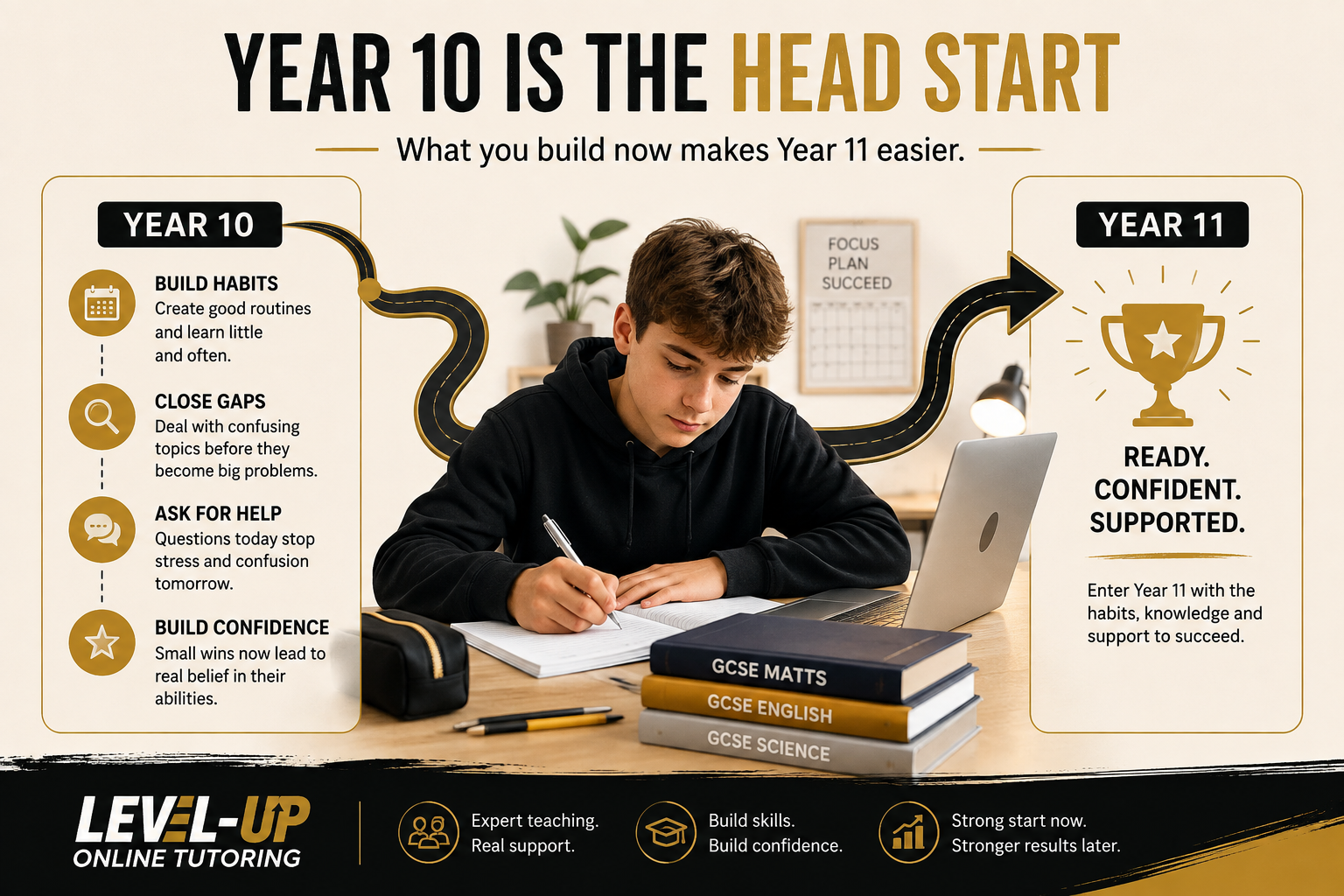
What students build in Year 10 can make Year 11 feel far more manageable: good habits, closed gaps, confidence and support.
How to help your child get off to a strong GCSE start
You do not need an elaborate revision timetable or hours of extra study. A strong Year 10 start is usually much simpler than that.
The Year 10 Strong Start
Five things that make GCSE life easier later
Keep up, rather than catch up
Deal with confusing topics as they appear instead of allowing small gaps to build for months.
Start small
Use short periods of learning regularly rather than waiting until revision suddenly feels urgent.
Ask questions early
Encourage your child to get help quickly when something does not make sense, before confusion turns into avoidance.
Build confidence alongside knowledge
Notice progress as well as grades. Small wins help students believe that improvement is possible.
Create a routine before Year 11
Make learning something that happens regularly rather than something reserved for mocks and exams.
Do Year 10 students need to start revising already?
Not in the way most parents imagine.
Your child does not need to spend every evening revising for GCSE exams that are still a long way away.
What is useful, though, is getting comfortable with revisiting learning.
That could mean:
- Spending 20 minutes reviewing something from that week’s lessons
- Watching a short tutorial when a topic feels unclear
- Answering a few questions without looking at notes
- Checking mistakes rather than ignoring them
- Asking for help before confusion becomes frustration
Think habits rather than hours.
Twenty focused minutes repeated regularly can be far more useful than suddenly trying to revise for three hours before a test.
This is exactly why we recommend students study little and often for GCSEs.
Spot learning gaps before they become confidence gaps
One of the biggest opportunities in Year 10 is catching problems early.
A student might miss one part of fractions. Then percentages become more difficult. Then ratio feels confusing. Eventually, they decide they are simply “bad at Maths”.
The same pattern can happen in Science or English.
A knowledge gap gradually becomes a confidence gap.
What parents may notice
- Avoiding particular subjects
- Getting frustrated quickly
- Saying “I can’t do this”
- Lower test scores
- Leaving homework until late
What might help
- Revisit the original gap
- Use another explanation
- Ask questions early
- Practise manageable problems
- Build a few small wins
Pay particular attention to Maths, English and Science
These core GCSE subjects build continuously, so small gaps can have a bigger effect later.
If Maths is already becoming difficult, Level-Up’s GCSE Maths Tuition Online support helps students identify gaps, revisit topics and build confidence before Year 11.
For Science, students can access support across Biology, Chemistry and Physics through our GCSE Science Tuition programme.
And if English is causing concern, our GCSE English Tuition Online support covers both English Language and English Literature.
Do not wait for Year 11 panic before getting support
Parents often wait until something goes badly wrong before looking for extra GCSE support.
A poor mock result arrives. Confidence crashes. Exams suddenly feel close. Then everybody tries to fix everything at once.
Year 10 gives families another option.
Parents do not need to become the GCSE revision manager
This is an important one.
When parents can see GCSEs approaching, it is very tempting to start monitoring homework, reminding about revision and asking whether everything has been done.
But if every conversation becomes about school, tension can build very quickly.
A better goal is to make sure your child has somewhere else to turn for academic support.
Your job does not have to be teaching GCSE Maths at the kitchen table. Your job can simply be helping your child access the right support when they need it.
How Level-Up supports students starting Year 10
Level-Up gives students somewhere to learn regularly, revisit difficult topics and ask for help without parents having to organise separate support every time something becomes difficult.
For Year 10 students, this means support can become part of normal life before GCSE pressure builds.
Inside Level-Up, students can access:
- 60+ live lessons every month across core GCSE subjects and more.
- Recorded sessions if they cannot attend live.
- Hundreds of hours of video tutorials to revisit topics whenever they need them.
- Teacher support when something does not make sense.
- Mental wellbeing, motivation and community support alongside academic learning.

Click the image to explore Level-Up and see how ongoing GCSE support can help your Year 10 child build confidence from the start.
Starting Year 10? Start the support before the stress.
Give your child somewhere to learn, ask questions and build good GCSE habits now, rather than waiting until Year 11 feels urgent.
Bottom line
Starting Year 10 should not mean starting GCSE panic. It is an opportunity to build the routines, confidence and support that will make the next two years much easier to manage.
Encourage your child to keep up rather than catch up, ask for help when something does not make sense and get comfortable learning little and often.
Do that now, and Year 11 can begin with far more confidence and far less pressure.
Mind reading: What Parents Can Do In Year 10 To Reduce GCSE Stress Later
Also helpful: Why Successful GCSE Students Study Little And Often