

If your child is starting Year 11, GCSEs can suddenly feel much closer than they did a few months ago. Mocks are approaching, teachers are talking more about grades, and students are beginning the final stretch towards their exams.
For parents, that can trigger a very understandable feeling of: Should we be doing more?
The answer is yes — but not by panicking, creating an enormous revision timetable or expecting your teenager to spend every evening studying.
A strong start to Year 11 is about getting organised, identifying gaps early, building a realistic routine and making sure your child knows where to get help before anything starts to feel overwhelming.
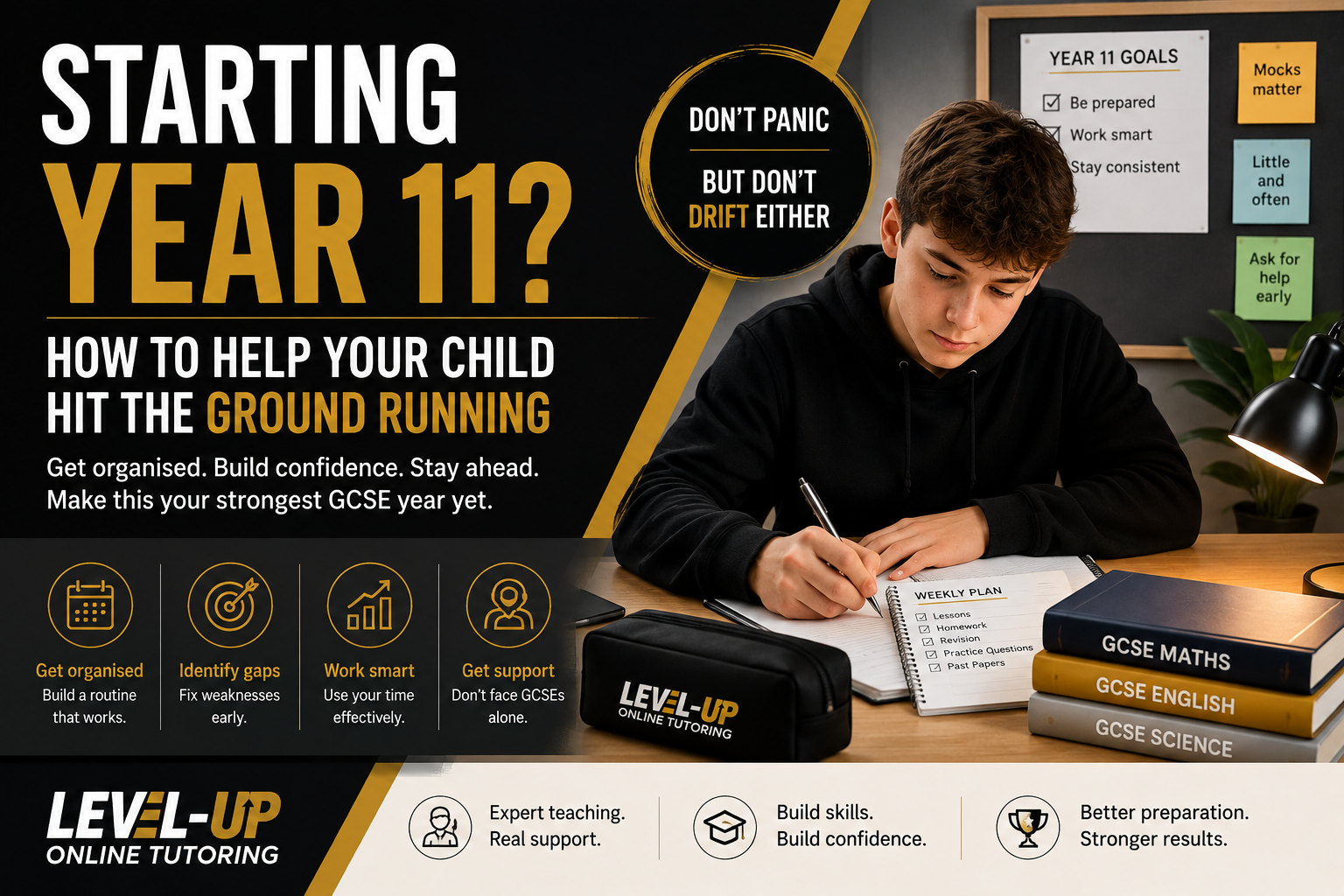
Don’t panic, but don’t drift either
Year 11 is not about cramming harder. It’s about working smarter, fixing gaps and building consistency from day one.
Want your child to start Year 11 with support already in place?
Level-Up gives students live GCSE teaching, recorded sessions, video tutorials and teacher support so they can deal with gaps before they become bigger problems.
What should students do when starting Year 11?
The temptation is to look at everything your child has to do between now and their GCSE exams.
That can make Year 11 feel enormous.
Instead, focus on the beginning.
The first few weeks of Year 11 are an opportunity to put simple systems in place while there is still plenty of time to improve.
Your child does not need to know everything yet. They do need to begin noticing:
- Which subjects already feel comfortable
- Where Year 10 knowledge feels shaky
- Which topics they repeatedly avoid
- Whether homework and deadlines are staying organised
- Where they need additional support
Helpful reframe: Year 11 does not need to start with more pressure. It needs to start with more clarity.
The first 6 weeks of Year 11 can set the tone
Students sometimes drift through September because GCSE exams still feel a long way away.
Then mocks arrive.
Suddenly weak topics matter, revision feels urgent and everybody wishes they had started a little earlier.
Using the first six weeks well can change that.
Start by finding out what did not quite click in Year 10
One of the most useful things a student can do at the start of Year 11 is look backwards before racing forwards.
Which topics from Year 10 still feel uncertain?
Perhaps algebra never really made sense. Maybe Chemistry calculations became confusing. Perhaps English Literature essays still feel difficult to structure.
Those gaps matter because many GCSE subjects build on earlier knowledge.
A simple question for your teen:
“If you could make three GCSE topics feel easier before mocks, which three would you choose?”
That question feels very different from:
“Have you started revising yet?”
It helps turn an enormous GCSE workload into something specific and manageable.
Year 11 is a marathon, not a sprint
Students sometimes start Year 11 with very good intentions and create an enormous revision schedule.
Then real life happens.
Homework increases, extracurricular activities continue, students get tired and the elaborate timetable disappears.
A better approach is consistency.
START STRONG → STAY CONSISTENT → FIX GAPS EARLY → GET SUPPORT → FINISH CONFIDENT
The students who cope best with Year 11 are not necessarily those who start by doing the most. They are often the ones who build habits they can actually maintain.
This is why studying little and often for GCSEs can be so helpful.
What should a realistic Year 11 study routine look like?
At the beginning of Year 11, revision does not need to take over family life.
A realistic routine might involve:
- Short, focused periods of learning during the week
- Reviewing recently taught material
- Returning regularly to weaker topics
- Answering practice questions to check understanding
- Using short tutorials when something has not clicked
- Leaving space for rest, friends, hobbies and sleep
The goal is not maximum revision in September. The goal is a sustainable routine your child can still follow in January.
Pay attention to the GCSE subjects that build on themselves
Maths, English and Science all benefit from dealing with difficulties early rather than allowing them to accumulate.
If Maths is already a concern, our GCSE Maths Tuition Online support helps students revisit difficult topics, ask questions and build confidence step by step.
For Biology, Chemistry and Physics, our GCSE Science Tuition support gives students regular access to help across all three sciences.
And students needing support with reading, writing, analysis and exam technique can explore our GCSE English Tuition Online programme.
Do not wait for mocks to reveal every problem
Mocks are useful because they show students what is working and what still needs attention.
But parents do not need to wait for a disappointing mock result before putting support in place.
Often there are signs much earlier:
Avoidance
Your teen repeatedly avoids one particular subject or topic.
Frustration
Homework quickly turns into “I can’t do this”.
Confusion
They can follow lessons but struggle to complete questions independently.
Confidence drops
One difficult subject starts affecting how capable they feel overall.
Getting support while those problems are still manageable is far easier than trying to solve everything under exam pressure later.
Parents do not need to manage Year 11 alone either
Year 11 can become stressful for parents too.
You want to help, so you ask about homework.
Then you ask about revision.
Then mocks.
Then deadlines.
Before long, every conversation seems to be about GCSEs.
You can be your child’s parent without becoming their GCSE revision manager. Putting good academic support around them can take some of that pressure out of the relationship.
How Level-Up supports students starting Year 11
Level-Up gives students regular access to teaching and support throughout their GCSE year, rather than waiting until something becomes urgent.
That means a student who gets stuck on Tuesday does not necessarily have to sit confused until their next one-to-one lesson or until somebody at home can help.
Students also have access to mental wellbeing, motivation and community support, because GCSE success is not only about subject knowledge.

Click the image to explore Level-Up and see how ongoing GCSE support can help your Year 11 child stay confident and on track.
Hit the ground running with support already in place.
Help your child close gaps, build good habits and stay ahead of the pressure as Year 11 gets busier.
Bottom line
Starting Year 11 does not mean it is time to panic. There is still time to close gaps, strengthen weaker subjects and build a routine that makes the months ahead feel much more manageable.
But this is also not the year to drift and assume there will always be time later.
Start well. Stay consistent. Ask for help early. Build confidence as you go.
Do that, and your child can approach their GCSE exams feeling far more prepared than if everything is left until after Christmas.
Mind reading: Why Successful GCSE Students Study Little And Often
Also helpful: What Parents Can Do In Year 10 To Reduce GCSE Stress Later