

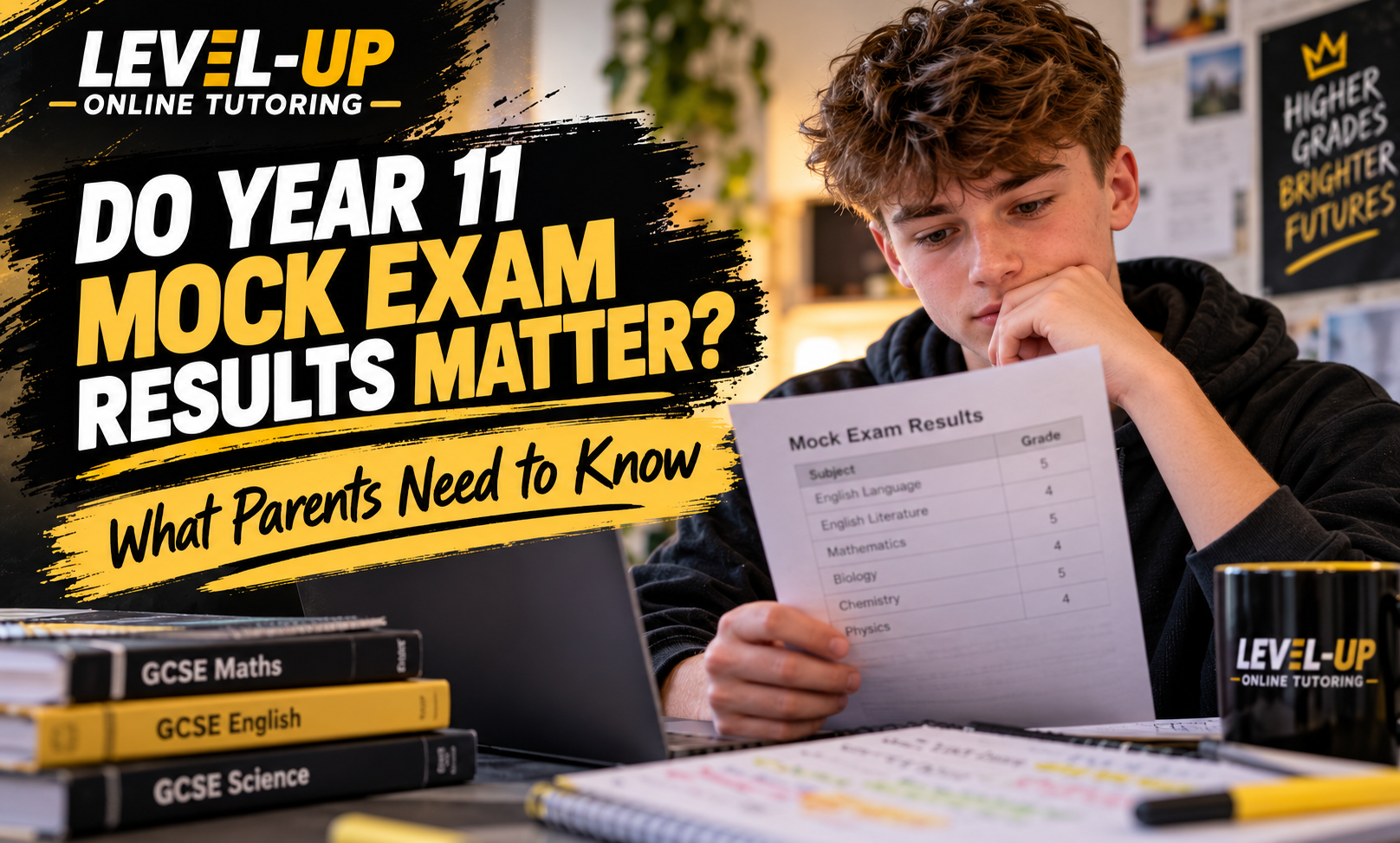
It's a moment many Year 11 parents know well.
Your teenager comes home with their mock exam results. Perhaps they've done better than expected. Perhaps they're disappointed. Or perhaps they're insisting the results don't matter anyway.
And suddenly you're wondering what those grades actually mean.
"Are these the grades they're going to get in their real GCSEs?"
The answer is more encouraging than you might think. But mock results shouldn't simply be ignored either.

At Level-Up Online Tutoring, we understand how much pressure GCSE mocks can create for families.
That's why we encourage parents to look beyond the grade itself. Mock results can highlight what a student already understands, where they're struggling and what kind of teaching or support could make a difference before their final exams.
In this third article in our Year 11 Mock Series, we'll explain how schools use mock results, whether they affect sixth-form applications and, most importantly, what parents can do next.
Worried About Your Teenager's Mock Results?
Discover how Level-Up supports Year 11 students with revision, confidence and wellbeing as they prepare for their GCSEs.
Yes, Year 11 Mock Results Matter. But They're Not the Final Word.
Mock exams don't normally contribute directly to a student's final GCSE grade.
However, schools may use the results to assess progress, identify learning gaps, inform predicted grades and help students prepare for their real exams.
So they're worth taking seriously, without treating them as a prediction that cannot change.
01. Mocks are practice.
02. Results provide useful evidence.
03. There is still time to respond.
What are Year 11 mock exam results actually used for?
GCSE mocks give students experience of sitting exams under timed conditions, often using questions and formats similar to those they'll encounter in the summer.
But they're useful for teachers too.
A mock paper can reveal things that aren't always obvious during ordinary lessons. A student might understand a topic in class but struggle to apply it independently, manage their time or explain their reasoning clearly in an exam answer.
Schools may use mock results in several ways.
Spotting learning gaps
Teachers can identify subjects, topics or exam skills where students may need further support.
Informing predictions
Mock performance may contribute to predicted GCSE grades, alongside other evidence of a student's work and progress.
Practising exam conditions
Mocks provide an opportunity to experience timed papers and identify exam technique that needs improving.
Schools may also use mock performance as part of discussions about exam entry tiers in subjects where Foundation and Higher papers are available.
Exactly how much weight a school gives to mock results varies. If you're unsure how your child's school uses them, it's worth asking.
Mock Grades vs Predicted Grades
Mock grade: The result a student receives from a particular practice exam or set of assessments.
Predicted grade: A teacher's estimate of the grade a student may achieve in their final qualification, based on available evidence.
One mock result isn't necessarily the whole picture
Schools may consider classwork, earlier assessments, progress over time and professional judgement when deciding predicted grades.
A disappointing mock result could influence a prediction, but it doesn't automatically mean a student cannot improve.
If you're concerned, ask the school how predictions are calculated and whether they can be reviewed as further evidence of progress becomes available.
Do Year 11 mock results affect sixth-form or college applications?
They can, although the effect depends on the school or college your teenager is applying to.
Many sixth forms and colleges consider predicted GCSE grades when making conditional offers because students haven't yet received their final results.
As mock results may help teachers form those predictions, they can indirectly influence the application process.
Some providers may also request mock grades or school reports directly.
However, a conditional offer is generally subject to the student meeting the relevant entry requirements with their actual GCSE results.
That's why it's important to look at the specific entry criteria for the sixth form, college or course your child is considering.
Questions to ask the sixth form or college
"A mock result may influence the next conversation. It doesn't necessarily determine the final outcome."
If your child has a particular course in mind, checking the provider's actual admissions policy is more useful than relying on general assumptions.
What if your teenager gets disappointing mock results?
This is often the moment when parents feel they need to do something immediately.
Perhaps you want to organise extra revision, find a tutor or explain why the results matter.
Those conversations may be important, but the first response can make a difference to how willing your teenager feels to talk about what went wrong.
Before jumping into solutions, try to understand how they feel about the results themselves.
Some teenagers will be upset. Others may be embarrassed, defensive or determined to act as though they don't care.
And sometimes a student who appears completely unconcerned is simply finding the situation difficult to talk about.

Start With Curiosity, Not Criticism
"How do you feel about the results?"
"Was there anything that surprised you?"
"Do you know which parts of the papers you found difficult?"
These questions open up a conversation about what happened, rather than turning the results into a judgement about effort or ability.
What if the results have left your teenager feeling overwhelmed?
If mock exams are affecting your child's confidence or wellbeing, academic revision may not be the only support they need. Explore our GCSE Stress & Wellbeing Support page for more information about Level-Up's approach.
The Grade Is Only
Part of the Story.
A mock result tells you what happened in one assessment. Understanding why it happened is what helps you decide what to do next.
A grade on a page
A student receives a grade 4 in a mock Maths exam.
That tells us something about their performance in that particular assessment.
But on its own, it doesn't explain which topics they understand, which questions caused difficulty or how their performance might change with further teaching and practice.
Look behind the grade
The most useful question isn't simply "Why that grade?"
It's "What would help them improve?"
This is why going through a marked mock paper with a teacher can be so useful. It can turn a disappointing result into specific areas to work on.
Rather than telling your teenager they need to revise more, you can begin to understand what they actually need to learn, practise or revisit.
What should parents do after GCSE mock results?
Once you've had a chance to talk about the results, the next step is to turn that information into something manageable.
At Level-Up, we believe this works best when students have access to the teaching and support they need, rather than being expected to work through every difficulty alone.
From Mock Results to a Useful Plan
01
Understand the feedback
Look at the marked papers, teacher comments and topics where marks were lost.
02
Choose the priorities
Identify the subjects or skills where extra teaching could make the biggest difference.
03
Find the right support
Use suitable lessons, recordings and teacher guidance to revisit those areas.
Progress begins when students know what to work on and where to get help.
How Level-Up can help students improve after their mocks
One of the challenges after mock exams is knowing how to act on the feedback.
A student may be told to work on algebra, improve their English Language responses or revisit particular Science topics.
But what happens if they still don't understand the material?
Simply adding more independent revision isn't always the answer.
Level-Up Online Tutoring gives students access to live subject teaching, recorded lessons and support from teachers, helping them revisit difficult areas with more guidance.
That means their revision can be informed by what the mocks have revealed, rather than becoming another long list of things they feel they ought to do.

More Than Just Revision Resources
Students can join relevant live lessons, watch recordings when they need flexibility and revisit topics they haven't yet mastered.
They also have opportunities to ask questions and benefit from the wider Level-Up community.
The aim is to make learning feel more supported and manageable as they work towards their final GCSEs.
Support for the Journey
Beyond Mock Results
60+
Live lessons per month
Opportunities to learn with subject teachers.
500+
Hours of video support
Recorded learning to revisit difficult topics.
15+
Teachers
Guidance when students need more explanation.
Plus weekly wellbeing support and a student community that recognises there's more to GCSE success than grades alone.
Your Teen Doesn't Have to Figure Everything Out Alone
With live lessons, recordings and teacher support, Level-Up gives students somewhere to turn when mock results reveal topics they haven't yet mastered.
What if mock results have affected your teenager's confidence?
For some students, a disappointing mock result can make them question their ability.
They might decide they're simply bad at Maths, that they'll never understand Science or that there's no point trying to improve.
Those feelings deserve attention alongside the academic work.
A grade can tell us something about performance in an assessment. It cannot tell us everything about a student's potential, character or future.
It may help to remind your teenager that finding a subject difficult isn't the same as being incapable of learning it.
And if the mocks have left them feeling overwhelmed, anxious or discouraged, additional emotional support may be just as important as subject teaching.
Level-Up includes weekly wellbeing support alongside its academic programme, recognising that confidence and emotional wellbeing matter too.
"A disappointing result is something to respond to, not something that defines your child."
Keep the conversation open
Try to avoid comparing your teenager's grades with friends, siblings or classmates.
Focus instead on what they've learnt from the experience and what support might help them move forward.
If anxiety is persistent or significantly affecting their everyday life, speak with their school or an appropriate health professional for additional support.
Should parents worry if their child fails a GCSE mock?
It's understandable to feel concerned, especially if your teenager needs particular GCSE grades for their next steps.
But failing a mock doesn't automatically mean failing the final exam.
It does mean there's a reason to look more closely at what's happening.
Perhaps your child has gaps in understanding. Perhaps they struggled with exam technique, revision or confidence. There may be more than one factor involved.
The important thing is to identify the issue early enough to respond constructively.
If a student is working below the grade they need, their teacher can help explain the gap and what improvement would realistically involve.
For families looking for additional support, Level-Up can complement school teaching by giving students further opportunities to learn and revisit difficult subjects.
Hear From Andy: How Level-Up Works
Andy Hoyland, founder of Level-Up Online Tutoring, introduces the programme and the wider support available to students.
If you're considering what to do after your teenager's mocks, it's a helpful introduction to the Level-Up approach.
Want to Understand the Programme Before Joining?
Level-Up offers a Tuesday Welcome Session where families can learn more about the programme, explore the support available and find out how to get started.
See whether Level-Up could be right for your teenager.
Explore the Tuesday Welcome SessionYear 11 Mock Results: Frequently Asked Questions
Do Year 11 mock results count towards final GCSE grades?
Under normal GCSE exam arrangements in England, mock exam grades do not directly count towards final GCSE grades. Final grades are awarded using the assessments specified for the qualification. Mocks can still influence school decisions and provide evidence of progress.
Do mock exam results affect predicted grades?
They can. Teachers may consider mock performance alongside classwork, other assessments and progress over time. The process varies between schools, so ask your child's school how it makes and reviews predictions.
Can you still get good GCSE grades if you fail your mocks?
Yes, improvement is possible. However, the amount of progress a student can make depends on their starting point, the time available and the support they receive. A disappointing mock is a reason to identify learning gaps and plan the next steps, not assume the final result is already decided.
Do sixth forms look at Year 11 mock results?
Some sixth forms and colleges request mock grades directly, while others rely on predicted GCSE grades or school reports. Requirements differ between providers and courses. Check the admissions policy for the places your child is considering.
Should my child revise differently after their mocks?
That depends on the feedback. If the mocks reveal gaps in subject knowledge, additional teaching may help. If timing or exam technique caused problems, those skills may need attention. A useful plan should respond to the specific issues identified rather than simply adding more revision hours.
How can I help my teenager feel better about disappointing mock results?
Listen to how they feel, avoid comparisons and focus on what can be learnt from the experience. Help them identify manageable next steps and where they can get support. If their distress is significant or persistent, speak with their school or an appropriate health professional.
Helping Parents Through Mock Season
In our first article, we explored when students should begin preparing for their mocks.
Our second article looked at creating a revision plan that makes use of real teaching and support.
Here, we've explored what mock results mean and how families can use them constructively.
Next, we'll look at what parents can do when their teenager is panicking about GCSE mocks.
Don't Let Mock Results Be the End of the Conversation
Level-Up combines live teaching, recordings, teacher support and wellbeing resources to help students continue learning beyond their mocks.
Bottom line
Year 11 mock exam results do matter. They can help teachers assess progress, inform predicted grades and highlight areas where students need more support.
They may also play a part in sixth-form or college applications, depending on the provider's admissions process.
But a mock result isn't the same as a final GCSE grade.
What matters now is understanding what the results are telling you and helping your teenager use that information constructively.
For some students, that will mean strengthening their subject knowledge. For others, it may mean improving exam technique, rebuilding confidence or finding support with the pressure they're experiencing.
The results themselves are only part of the story. What your teenager does with the feedback, and the support they receive afterwards, is where the next chapter begins.
Your teenager's mock results are not a definition of their potential. They're an opportunity to understand what help they need next.
Mind reading:
When Should My Child Start Revising for Year 11 Mocks?
How to Make a GCSE Mock Revision Plan Your Teen Will Actually Follow
For further information about how final GCSE grades are awarded in England, see Ofqual's guide to GCSE and A level grading . For individual predicted grades and post-16 applications, always check the policies of your child's school and chosen provider.