

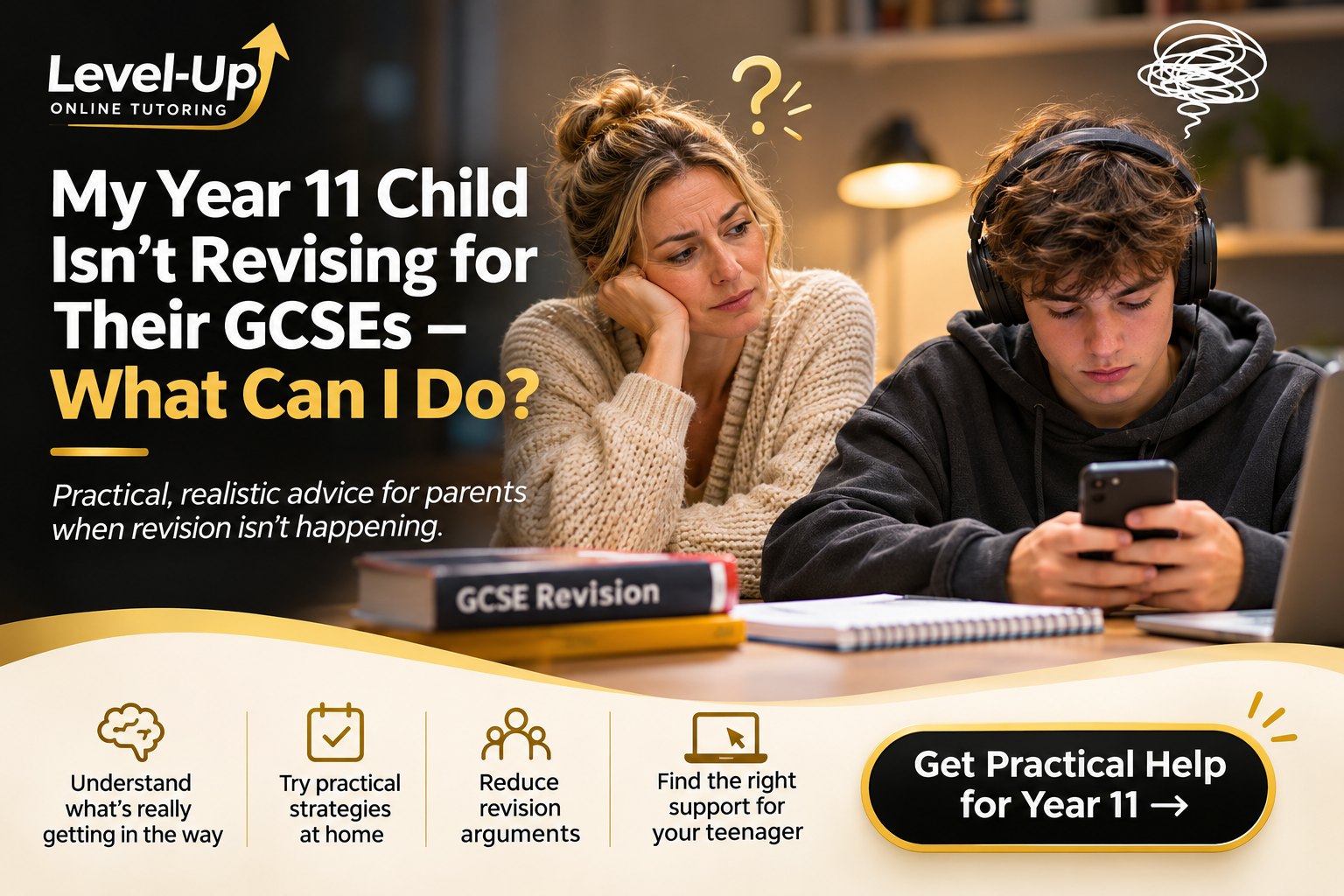
My Year 11 Child Isn't Revising for Their GCSEs – What Can I Do?
If you're worried about your Year 11 child not revising, you're certainly not the only parent having this conversation.
You've reminded them. You've encouraged them. You've asked whether they've started. And somehow, you're having exactly the same conversation again.
But what if the problem isn't simply that your teenager doesn't want to revise?
Let's look at what's really getting in the way, how to make revision feel more manageable and how to help without turning every evening into an argument.
Live GCSE lessons, recordings and support from experienced teachers.
What looks like laziness can sometimes be overwhelm, anxiety or not knowing where to start. Understanding the reason behind the avoidance is often much more useful than another reminder to revise.
They're Not Revising. And You're Getting Worried.
Your teenager has GCSEs ahead of them, but instead of opening a textbook, they're scrolling through their phone, watching YouTube or telling you they'll start tomorrow.
It's frustrating, isn't it?
Particularly when you know they're capable of doing well and you can see the weeks passing.
Perhaps you've tried being encouraging. Maybe you've offered rewards. You might even have created a revision timetable together.
And yet nothing seems to have changed.
Here's something worth considering: your teenager might be finding revision much harder to begin than you realise.
Once you understand what's stopping them, it's much easier to find a way forward.
Five Reasons Your Year 11 Child Might Not Be Revising
It's easy to assume they simply don't care. But there may be much more going on.
They're Completely Overwhelmed
Imagine being told you need to revise everything you've learned across multiple subjects over several years.
Where would you start?
When the workload feels enormous, avoiding it can seem easier than deciding what to tackle first.
They Don't Understand the Work
There's a difference between revising something you've learned and trying to teach yourself something you never properly understood.
If a topic didn't make sense in class, reading the same notes again may not be enough.
They might need someone to explain it differently.
They're Frightened of Failing
Some teenagers avoid revision because they're worried about discovering how much they don't know.
If they never really try, they don't have to confront the possibility that trying might not be enough.
Helping them believe that improvement is possible can make a real difference.
They Don't Know How to Revise
Being told to "go and revise" isn't particularly helpful if nobody has shown you how to do it effectively.
Your teenager may need guidance on choosing topics, checking their understanding and using active revision techniques.
Simply reading notes repeatedly isn't always enough.
They're Tired of Being Reminded
Let's be fair to teenagers for a moment.
They've spent the day at school, they've got homework, friendships and plenty of other things on their minds.
Then they get home and hear: "Have you done any revision?"
Again.
Even when that question comes from a place of love and concern, it can feel like another demand. Before long, revision itself becomes a source of conflict.
Take Some of the Pressure Off at Home
With 60+ live GCSE lessons every month, recordings and daily opportunities to ask teachers questions, Level-Up gives your teenager another place to turn when they need help.
What Parents See... And What Teenagers Might Be Feeling
Sometimes you're both worried about exactly the same thing. You're just expressing it differently.
You're thinking about their future, their opportunities and how much you want them to succeed.
They might be struggling with confidence, feeling overwhelmed or worried about disappointing people.
Neither of you is necessarily wrong.
But the conversation can stop being about learning and start being about pressure.
And that's when even a well-meant reminder can lead to another argument.
Try Changing the Question
Instead of asking: "Why haven't you started revising?"
Try: "Which subject is worrying you the most at the moment?"
Or: "Is there something you're finding difficult that we could get some help with?"
You're opening the door to a conversation rather than another disagreement.
Sometimes your teenager doesn't need another reminder to work harder. They need someone to help them get started.
What Can You Actually Do to Help?
The good news is that you don't need to become a GCSE expert or spend every evening supervising revision.
A few small changes can make the whole process feel more manageable.
Start With One Subject, Not Everything
Forget the enormous revision timetable for a moment.
Ask your teenager to choose one subject they're finding difficult. Then one topic within that subject.
That's it.
Instead of saying, "Revise Science tonight", try suggesting 20 minutes on a specific Biology topic they weren't sure about.
A clear, achievable task is much less intimidating than an entire evening of unspecified revision.
Help Them Find Answers, Not Just More Work
If your teenager doesn't understand something, they need an explanation before they can revise it effectively.
That might mean asking their subject teacher, getting targeted tutoring or joining an online GCSE lesson.
The important thing is having somewhere to turn when they get stuck.
Because nothing kills motivation quite like sitting in front of a question you can't answer.
Explore our GCSE Maths support, GCSE English support and GCSE Science support.
Give Them Some Choice
Teenagers are often more willing to engage with a plan they've had a say in creating.
Instead of deciding exactly when and how they should revise, offer a couple of realistic choices.
"Would you rather do a little revision after school or after dinner?"
"Do you want to start with Maths or English?"
"Would you prefer joining a live lesson or watching a recording later?"
You're still helping them move forward, but they're taking some ownership of the process.
Notice the Effort, Not Just the Grade
It's easy for GCSE conversations to become dominated by results.
But if your teenager has been avoiding revision and finally sits down to tackle something difficult, that's worth recognising.
They've started. They've made an effort.
A simple "I'm glad you gave that a go" can sometimes be more motivating than another discussion about predicted grades.
Know When to Step Away
Sometimes the most useful thing you can do is stop trying to be their teacher.
You can suggest something perfectly sensible, and your teenager will dismiss it immediately.
Then a teacher says almost exactly the same thing, and suddenly it's a brilliant idea!
Frustrating? Absolutely. Unusual? Not at all.
Outside support can give teenagers someone else to learn from, ask questions and build confidence with.
Sometimes the best GCSE support means you get to be their parent again, rather than their full-time revision manager.
Less Pressure. More Support.
What if your teenager had somewhere to turn when they didn't understand something — without every question becoming a conversation with you?
That's one of the things Level-Up Online Tutoring is designed to offer.
Not another enormous revision task to add to their list.
But access to live teaching, recorded lessons, teachers who can answer questions and a supportive learning community.
Some students find the structure of a live lesson helps them get started.
Others prefer to watch a recording in their own time.
And for a teenager who feels embarrassed about not understanding something, knowing they can ask for help can be particularly reassuring.
The aim is to make GCSE learning feel more manageable, not to pile on even more pressure.
- Every live lesson is recorded, so students can catch up later.
- Weekly wellbeing sessions help support confidence and motivation.
- Tuesday welcome sessions help new students settle in.
- Support across key GCSE subjects.
- Flexible ways to learn that fit different students and routines.
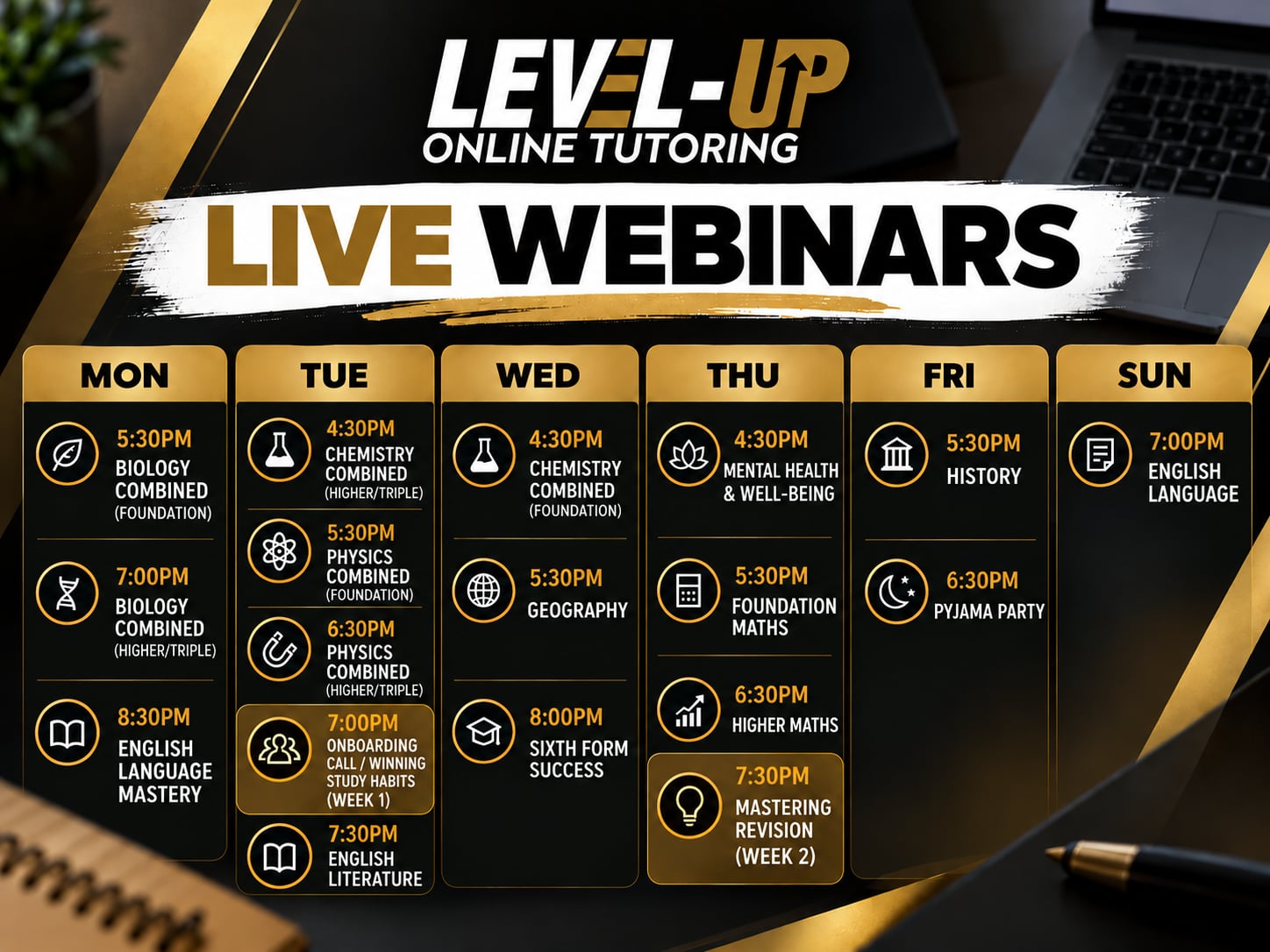
See What a Typical Month at Level-Up Looks Like
Here's an example of one of our live lesson timetables from October 2026, showing the variety of GCSE support available at Level-Up.
Timetables change throughout the year, but every live lesson is recorded, so students can catch up whenever suits them.
A Different Kind of Revision Conversation
If you've been stuck in the same pattern of reminders and arguments, here's something worth trying.
Choose a calm moment when neither of you is already frustrated.
Instead of launching into another discussion about how much revision they haven't done, you could say:
"I know I've been going on about revision, and I don't want us to keep arguing about it. I'm worried because I want you to have as many choices as possible after your GCSEs. Is there one subject you're finding difficult that we could get some help with?"
Then listen.
You might discover that your teenager isn't sure where to begin.
Or that they're embarrassed about how far behind they feel.
Or perhaps they're doing better than you realised but need some help organising their time.
Whatever the answer, you've started a conversation rather than another argument.
And that matters.
What If Their Mock Results Weren't Great?
Mock results can sometimes be the moment when concerns about revision become more urgent.
Perhaps your teenager didn't get the grades they expected.
Or perhaps the results confirmed something you've suspected for a while: they're struggling in certain subjects.
It's understandable to worry.
But mock results can also give you something useful to work with.
Look Beyond the Grade
Which subjects need attention? Are there particular topics they don't understand?
Would additional teaching help? Or is confidence and exam anxiety the bigger problem?
The aim is to identify the next step, not simply focus on what went wrong.
A disappointing result doesn't have to become another source of pressure.
It can be the starting point for a more focused plan.
Our Year 11 Mock Exam Support page explains how to use mock results to identify where extra help might be useful.
How Much Revision Should a Year 11 Student Do?
It's a question lots of parents ask.
But there's no single revision timetable that's right for every teenager.
A student who's confident in most subjects may need something very different from one who has significant gaps in their understanding.
And a teenager who's already feeling anxious or overwhelmed may struggle with an ambitious schedule.
What matters is that revision is realistic, consistent and actually helping them learn.
A shorter session with a clear purpose can be more useful than a long evening spent distracted or staring at notes.
If your teenager isn't doing any revision at all, focus on establishing a manageable starting point.
Build from there.
When Should You Be More Concerned?
There's a difference between ordinary teenage reluctance to revise and a student who's struggling emotionally.
If your teenager seems persistently anxious, withdrawn, exhausted or distressed about school and exams, it's worth looking beyond revision habits.
Speak to their school about what you've noticed and what support may be available.
Their wellbeing matters just as much as their academic progress.
Level-Up also recognises the importance of emotional support alongside GCSE learning.
You can find out more on our GCSE Stress and Wellbeing Support page.
Look for the Small Wins
Your teenager doesn't need to suddenly transform into someone who spends every spare minute studying.
They finally sit down and make a start on something they've been avoiding.
Something they've struggled with for months suddenly starts to make sense.
They ask for help instead of giving up when they don't understand.
Those little moments build confidence.
And confidence can make it easier to keep going.
Your child doesn't need a perfect timetable.
And you don't need to spend the next few months arguing about revision.
What they need is a way to make progress that feels achievable.
Year 11 Child Not Revising? Your Questions Answered
Why won't my Year 11 child revise for their GCSEs?
There can be several reasons, including feeling overwhelmed, not understanding the work, worrying about grades or not knowing how to revise effectively. Try asking what they're finding most difficult before assuming they simply lack motivation.
How do I motivate my teenager to revise?
Start with small, realistic goals and give them some choice over when and how they study. Help them find explanations for topics they don't understand, and recognise effort as well as results.
Should I keep reminding my child to revise?
Occasional reminders may help, but constant reminders can create tension and resistance. Try agreeing on a manageable routine together and checking in supportively rather than repeatedly asking whether they've revised.
What if my child is too overwhelmed to start revising?
Break the task down into one subject and one small topic. Help them identify what they need to understand first. If they're persistently distressed, speak to their school about additional support.
Can online GCSE tutoring help a child who won't revise?
It can help some students by providing structured live lessons, recordings, explanations and opportunities to ask questions. The aim is to make learning more accessible and manageable, although the student still needs to engage with the support.
How does Level-Up help Year 11 students?
Level-Up offers more than 60 live GCSE lessons per month, recordings of every lesson, daily support from over 15 teachers, a large video resource library and weekly wellbeing sessions. Students can choose the parts of the programme that suit their needs.
Let's Make GCSE Revision Feel Less Overwhelming.
Your teenager doesn't have to figure everything out alone. And you don't have to become their Maths teacher, English tutor and revision coach all at once!
With the right teaching, encouragement and flexibility, your Year 11 student can begin building the confidence and habits they need to move forward.
Discover how Level-Up can help your teenager feel more supported and better prepared for their GCSEs.
Want to hear from other families? Read our 5-star reviews.