


If you’re looking for GCSE support for teens because you’re worried about your child, it isn’t always easy to know what to do next.
Perhaps they seem more stressed than usual. Maybe their confidence has dropped, they’re struggling to get started, they’re avoiding certain subjects or schoolwork is beginning to cause tension at home.
You know their GCSE results matter.
But you’re also worried about them.
And that is an important distinction.
The two things are connected
Supporting your teen’s wellbeing and supporting their GCSE progress don’t have to be two separate jobs.
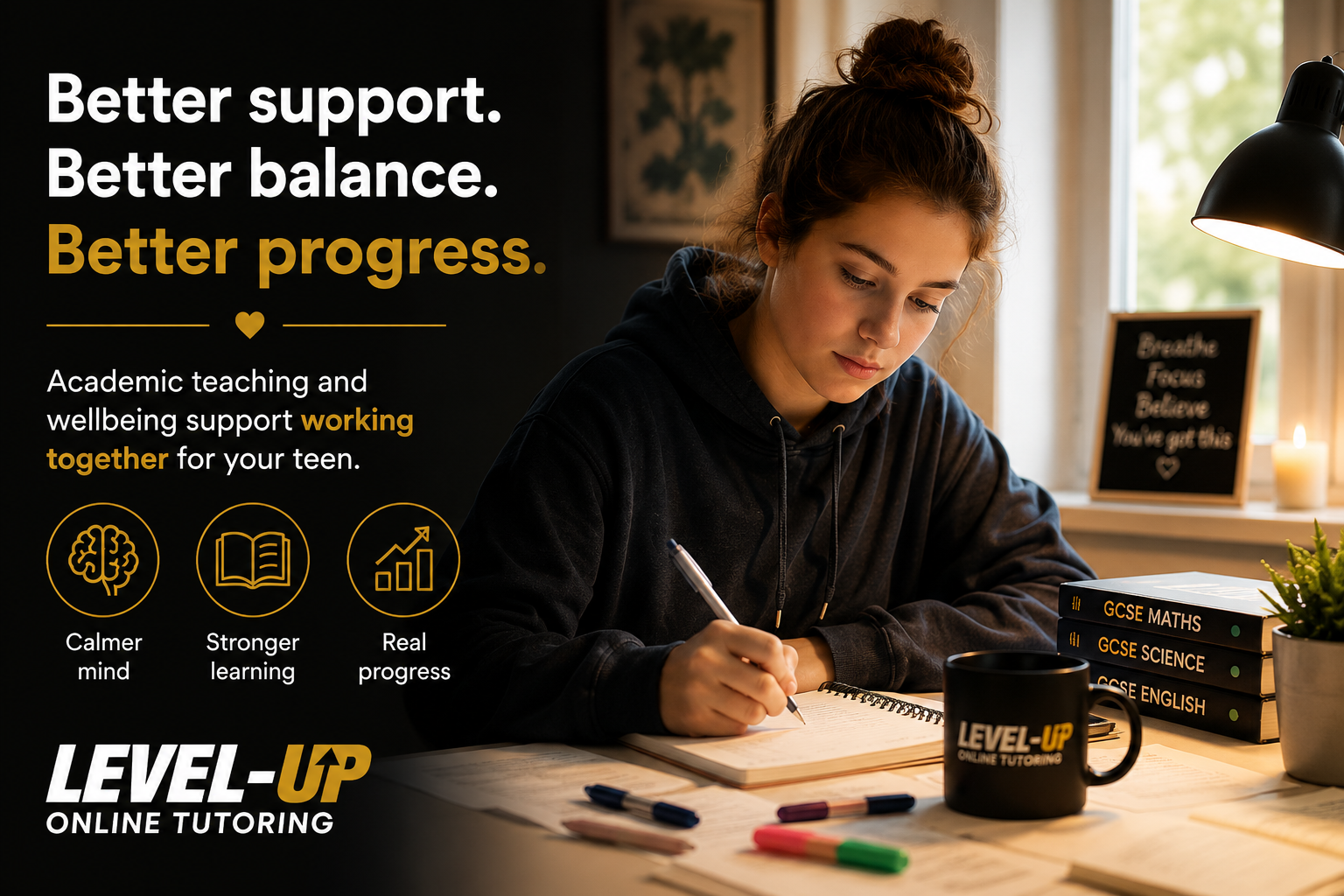
A student who feels calmer, supported and able to ask for help is in a much better position to learn.
And a student who finally understands the topic they’ve been worrying about may begin to feel calmer and more confident too. This is why the right GCSE stress and wellbeing support can be such an important part of the bigger picture.
Does your teen need support with both GCSE learning and the stress surrounding it?
See how Level-Up combines academic teaching with practical wellbeing support.
What kind of GCSE support does your teen actually need?
Sometimes parents know something isn’t quite right before they can put their finger on exactly what the problem is.
Your teenager might still be going to school and completing some of their work, but you may notice small changes.
THEY’RE STRESSED
GCSE conversations quickly become emotional or overwhelming.
THEY CAN’T GET STARTED
They know they need to do something, but seem unable to begin.
CONFIDENCE IS DROPPING
“I don’t understand this” starts turning into “I’m just rubbish at it”.
THEY’RE AVOIDING WORK
Difficult subjects or topics are repeatedly being pushed aside.
None of those signs automatically tells you exactly what’s wrong.
But they can tell you that simply saying “you need to revise more” may not be enough.
It is one reason we often encourage students to build a manageable routine and study little and often for their GCSEs, rather than waiting until everything feels urgent.
Sometimes the first step in GCSE support isn’t more revision
If a teenager is already feeling stressed or stuck, piling more work onto them can sometimes make the mountain feel even bigger.
Before students can use academic support well, it can help for them to understand what is happening for them in that moment.
That is an important part of what makes Level-Up different.
Specialist Wellbeing Support
Meet Rachel Bee, Level-Up’s Wellbeing Specialist
Alongside its academic teachers, Level-Up brings in specialist wellbeing expertise too. Rachel Bee works with Level-Up students each week, helping them build self awareness and practical strategies for handling stress, getting unstuck and becoming more ready to learn.

Rachel’s aim isn’t for every student to respond in exactly the same way.
It is to help them become more curious about themselves, notice what they need and discover which strategies actually work for them.
What does a GCSE wellbeing toolkit actually look like?
It doesn’t have to mean complicated techniques.
Rachel uses simple activities regularly so students become familiar with them and can begin using them outside the session too.
One of Rachel’s favourite techniques begins with two words
Two very useful words
“I wonder…”
In Rachel’s sessions, students might look at an unusual picture, a short video or something as simple as animals eating and begin wondering about what they can see.
Where are they? What might they be thinking? What happened before the picture was taken? What could be happening next?
There isn’t necessarily a correct answer.
And that’s partly the point.
Teenagers preparing for GCSEs spend a lot of their time in a world where answers are marked right or wrong.
Giving them permission to simply wonder encourages curiosity and problem solving without the pressure of immediately needing to be correct.
That same thinking can be taken into real problems: “I wonder what’s making this difficult?” “I wonder what would make starting easier?” “I wonder what I could try next?”
The goal isn’t always to go from stressed to completely calm
Rachel shared a lovely example from one of her students.
The student had practised a short breathing exercise during the wellbeing sessions and later tried using the same technique when she was highly stressed.
She came back and told Rachel that it hadn’t worked.
Rather than deciding that breathing simply wasn’t useful for her, Rachel encouraged her to think about how different the two situations were.
If four breaths helped when she was already relatively calm, might she need more when her stress level was much higher?
The student experimented with it herself.
When she returned the following week, she was excited to report that she’d worked out what helped her.
She hadn’t failed at the technique
She had learned how to adapt it to herself.
She found that when she was highly stressed, she needed significantly more breaths before she felt able to think clearly again.
That experience then became another tool she understood how to use for herself.
And that is a powerful distinction.
The goal isn’t necessarily to make every difficult feeling disappear.
Sometimes it is simply to help a teenager move from feeling overwhelmed to feeling able to think, make a decision and take the next step.
Self awareness can make GCSE support more useful
Rachel also regularly encourages students to notice where they are emotionally and energetically.
They may check in with themselves on a simple scale, think about their current energy level and notice that there isn’t necessarily a “good” or “bad” place to be.
Different states may simply be better suited to different things.
Over time, students can begin recognising their own patterns.
Rachel described one regular student who had noticed such a change that she told Rachel how much more self aware she had become.
That’s important because a teenager who begins noticing:
- “I’m too wound up to concentrate right now”
- “I’m avoiding this because I don’t understand it”
- “I’m finding it difficult to start”
- “I need to ask someone to explain this differently”
- “I know something I can try before I give up”
is beginning to develop skills that can make academic support easier to use.
What if your teen struggles to get started?
This is another area Rachel works on practically.
Some teenagers know exactly what they’re supposed to do but find initiating the task particularly difficult.
Rachel is mindful that students may have different kinds of brains and different experiences of motivation, including neurodiverse students.
So sometimes the wellbeing session isn’t about a big emotional discussion at all.
It can simply be about practical strategies that make getting started easier.
A useful question
Instead of “Why haven’t you started?”, try “What would make starting feel easier?”
That changes the conversation from blame to problem solving.
Parents who are trying to support a teenager without creating more tension may also find our guide to reducing GCSE stress before it builds helpful.
GCSE support for teens needs to include academic help too
This is where Level-Up’s approach becomes particularly useful.
A teenager can learn how to settle themselves, recognise what they’re feeling and become better at getting started.
But if they open their Maths work and still don’t understand algebra, they need somebody who can help with algebra.
If Chemistry doesn’t make sense, they need academic support.
If they don’t know how to structure an English answer, they need teaching and guidance.
Ready to learn + able to get help
That’s where wellbeing support and academic support start working together.
From worried parent to supported teen
You don’t have to diagnose exactly what is wrong before deciding your teenager could use some support.
Sometimes it helps to think of the journey more simply.
How Level-Up provides GCSE support for teens
Level-Up gives students access to academic teaching throughout their GCSE studies alongside support for confidence, motivation and wellbeing.
Students who need subject-specific support can also explore our GCSE Maths tuition, GCSE Science tuition and GCSE English tuition online.

Worried about your teen?
You don’t have to wait until they’re completely overwhelmed before putting support around them.
Give them somewhere to learn, ask questions, get unstuck and develop practical strategies for handling the pressure of GCSEs.
WANT TO UNDERSTAND THE WELLBEING SUPPORT FIRST?
Explore how Level-Up supports GCSE stress, confidence and wellbeing alongside academic progress.
Bottom line
If you’re worried about your teenager during their GCSE years, you don’t have to choose between caring about how they feel and caring about how they perform academically.
Both matter.
And very often, they influence each other.
The right GCSE support for teens should give students somewhere to turn academically while also helping them feel more confident, supported and able to handle difficult moments.
The aim isn’t to remove every difficult GCSE moment.
It’s to make sure your teen has the support and tools to handle those moments and keep moving forward.
Mind reading:
GCSE Stress & Wellbeing Support
Also helpful:
Why Successful GCSE Students Study Little And Often