


What Are My Options for Helping My Year 11 Child Do Well in Their GCSEs?
Wondering how to help your child with GCSEs without turning every evening into another battle over revision?
Should you find a private tutor? Encourage more revision at home? Rely on school? Or is there another way to give your teenager the support they need?
The good news is that you've got options. And finding the right one doesn't have to be complicated.
Discover the live lessons, recordings and support available before deciding what's right for your teenager.
There isn't one perfect way to support a Year 11 student. School support, independent revision, private tutoring and online GCSE lessons can all help. The best choice depends on what your child is finding difficult, how they learn and what they'll actually use.
Year 11 Has Arrived. Now What?
One minute your child is starting secondary school. The next, everyone seems to be talking about mock results, predicted grades, revision timetables and GCSE exams.
And somewhere in the middle of all that, you're wondering whether you're doing enough to help.
Perhaps your teenager is working hard but not getting the results they hoped for. Maybe they're putting revision off. Or perhaps they're doing reasonably well, but you know they could benefit from a little extra confidence.
The first thing to remember is that more revision isn't automatically the answer.
Sometimes a student needs a better routine. Sometimes they need a tricky topic explained differently. Sometimes they simply need to know that there's someone they can ask when they get stuck.
Let's look at the different types of GCSE support available, the advantages of each and how to decide what might work best for your teenager.
Four Ways to Support Your Year 11 Child
Each approach has its place. The question isn't which one is universally best, but which one is right for your child.
School Support
Extra revision sessions, subject teachers and school resources.
Revision at Home
Manageable routines, practice and independent learning.
Private Tutoring
Individual attention and focused help in particular subjects.
Online GCSE Support
Live lessons, recordings and flexible access to teachers.
Give Level-Up a Try — Free for 7 Days
With 60+ live lessons each month, recordings and access to teachers, your teenager can explore the programme and discover how Level-Up works for them.
Where Should You Start?
Make the Most of School Support
Before arranging anything extra, it's worth checking what your child's school already offers.
Many schools provide additional revision sessions, subject-specific help and opportunities to speak to teachers about areas of weakness.
A useful starting point is to ask which topics your teenager should prioritise and whether they're struggling with understanding the material or remembering what they've already learned.
School support can be excellent, but teachers are helping lots of students. Your child may still need opportunities to revisit topics or ask questions outside the classroom.
“If we focused on just two or three things over the next few weeks, what would make the biggest difference?”
Make Revision at Home Feel Manageable
We've all seen those beautiful colour-coded revision timetables. They look incredibly organised.
Whether your teenager actually follows one is another matter!
For a student who feels overwhelmed, it's often better to begin with one subject, one topic and a realistic amount of time.
Short, focused sessions, regular breaks and clear goals can be much more useful than an ambitious timetable that falls apart after two days.
But there's an important distinction here.
If your teenager never understood a topic in the first place, they may need someone to teach it again before revision can really help.
That distinction can save a lot of frustration for everyone.
Sometimes your teenager doesn't need to work harder. They need someone to explain it differently.
Private Tutor or Online GCSE Support?
Both can be valuable. But they offer different kinds of help, and it's worth understanding the difference.
One-to-One Private Tutoring
A private tutor can provide personalised attention, identify gaps and adapt teaching to your child's pace.
Particularly useful when:- Your child needs focused help in one subject.
- They benefit from individual attention.
- They have a specific topic or learning difficulty to work through.
Things to consider
Appointments usually happen at set times. If your child needs support across several subjects, arranging multiple tutors can become complicated.
And when a question comes up between lessons, they may have to wait until their next appointment.
Online GCSE Tutoring & Support
Online programmes can offer a wider range of lessons and resources, with the flexibility to revisit topics when needed.
Particularly useful when:- Your teenager needs help in several subjects.
- They want to revisit explanations at their own pace.
- They benefit from live lessons and recordings.
- They need opportunities to ask questions between lessons.
Things to consider
Different programmes offer different levels of support. Look for genuine access to teachers, not simply a library of videos.
And make sure the format feels comfortable for your child.
It's not necessarily an either/or decision. Some students benefit from one-to-one tutoring in a particular subject alongside broader online GCSE support.
More Than Just Another Revision Resource
Imagine your teenager getting stuck on a Maths question and knowing there's somewhere they can turn for help.
Or missing a live Science lesson but being able to watch the recording later.
Or feeling overwhelmed and having access to support that looks after their wellbeing as well as their grades.
That's the thinking behind Level-Up Online Tutoring.
It's designed to make GCSE help more accessible, flexible and encouraging, with different ways for students to learn.
Some teenagers love joining live lessons. Others prefer to watch recordings and work through topics at their own pace. Many benefit from knowing they can ask questions when they're unsure.
The aim isn't to pile on more pressure. It's to help students feel more capable and supported.
- Every live lesson is recorded for students to watch later.
- Weekly wellbeing sessions support confidence and motivation.
- Tuesday welcome sessions help new students get started.
- Support across key GCSE subjects.
See What a Typical Month at Level-Up Looks Like
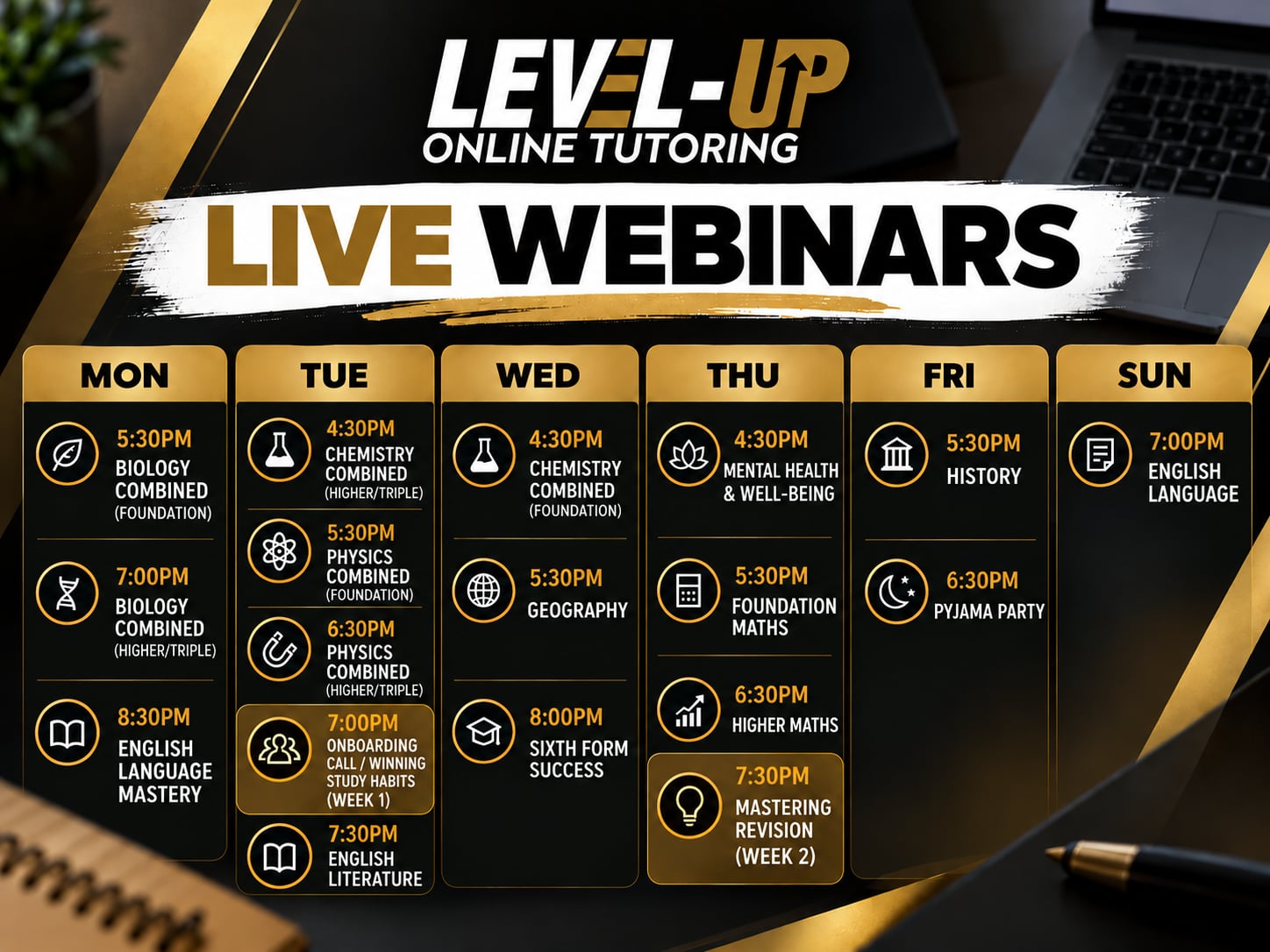
Here's an example of one of our live lesson timetables from October 2026, giving you a flavour of the variety of GCSE support available at Level-Up. Timetables change throughout the year, but every live lesson is recorded, so students can catch up whenever suits them.
What Parents See... and What Teenagers Might Be Feeling
Sometimes the same situation looks completely different depending on which side of the bedroom door you're standing.
“They're not revising. They're always on their phone. I'm worried they're leaving everything too late.”
It's understandable to feel concerned when you know how important these exams are.
“There's so much to do. I don't know where to start, and I'm worried I'm already behind.”
What looks like a lack of motivation can sometimes be stress, low confidence or feeling overwhelmed.
So what helps?
Instead of opening with “Have you done your revision?”, try asking which subject feels hardest at the moment.
Or whether there's something they've been struggling to understand but haven't wanted to ask about.
A smaller, more specific conversation can be much easier than discussing the entire GCSE exam season at once.
And if your teenager is particularly anxious, remember that emotional support matters too. You can read more on our GCSE Stress and Wellbeing Support page.
What's Actually Getting in the Way?
Start with the problem rather than the solution.
They Don't Understand the Work
Look for additional teaching and opportunities to ask questions, whether that's through a subject teacher, private tutor or online GCSE lessons.
They Understand, but Aren't Revising
Focus on realistic routines, manageable goals and helping them identify what to revise first.
Start small and look for ways to build confidence rather than adding more pressure.
They're Worried About Their Results
Talk about what the results have shown and which areas could improve with support.
Our Year 11 Mock Exam Support page offers more guidance.
The Best Support Is the Support Your Child Will Actually Use
It's tempting to think that more is always better.
More revision. More practice. More reminders. More tutoring.
But what really matters is whether your teenager is learning, making progress and feeling supported.
For one student, that might mean a private tutor who helps them finally understand algebra.
For another, it could mean joining an online lesson, watching the recording again and having somewhere to ask a question without feeling embarrassed.
And for someone else, it might simply mean creating a manageable revision routine and realising they know more than they thought.
Don't underestimate small wins.
One difficult topic that finally makes sense. One question answered. One revision session that actually happens.
Those little moments build confidence, and confidence makes it easier to keep going.
You don't have to wait until things are going badly to explore extra support. Getting help early can give your teenager more time to strengthen their understanding and develop useful habits.
Year 11 GCSE Support: Your Questions Answered
How can I help my child with GCSEs at home?
Start by asking which subjects or topics they're finding most difficult. Help them create a manageable revision routine, encourage breaks and make sure they have access to explanations when they don't understand something. Try to keep conversations supportive rather than focused entirely on grades.
Does my Year 11 child need a private tutor?
Not necessarily. A private tutor can be very helpful for specific learning gaps or students who need individual attention. However, school support, independent revision and online GCSE tutoring can also be effective, depending on your child's needs.
What if my Year 11 child refuses to revise?
Try to understand what's behind the reluctance. They may be overwhelmed, unsure where to start or worried about falling behind. Begin with a small, achievable task and give them some choice over how they study. If anxiety is a significant factor, it's important to address that too.
Is online GCSE tutoring as useful as face-to-face tutoring?
Both approaches can be useful. One-to-one tutoring offers individual attention, while a well-supported online programme can provide live teaching, recordings, access to teachers and help across several subjects. The best fit depends on how your teenager learns and the support available.
Can my child still improve their GCSE grades during Year 11?
Yes, improvement is possible, although the amount will depend on their starting point, learning gaps and the time available. Identifying priorities, getting help with difficult topics and practising consistently can all contribute to progress.
How does Level-Up help Year 11 students?
Level-Up provides more than 60 live GCSE lessons each month, recordings of every lesson, daily access to support from over 15 teachers, a large video resource library and weekly wellbeing sessions. Students can use different parts of the programme according to their needs.
Let's Help Your Year 11 Feel More Confident About Their GCSEs.
Your teenager doesn't have to figure everything out alone. And you don't have to become their Maths teacher, English tutor and revision coach all at once!
Explore the Level-Up programme, discover the support available and see whether it's the right fit for your family.
Want to hear from other families? Read our 5-star reviews.