


If you’ve ever thought, “I want my child to do well in their GCSEs, but not at the expense of their mental health”, you’re in exactly the right place. This post is a calm, practical guide for parents who are trying to work out how to support GCSE results and mental health at the same time – without lowering standards, giving in on everything, or turning home into a pressure cooker.
Why this feels like an impossible balance
GCSEs are a big deal. They influence college choices, apprenticeships and future options – and you can’t help but care about that. At the same time, you’re seeing:
- More talk than ever about anxiety, burnout and overwhelmed teens.
- Your own child feeling stressed, stuck or “switched off”.
- Messages from school that sometimes sound like “everything depends on this year”.
It’s no wonder many parents quietly ask themselves:
- “How do I keep expectations high but fair?”
- “How do I support their mental health without letting them give up?”
- “How do I talk about GCSEs without making them panic?”
You don’t have to choose between “push them hard and hope they cope” and “back off and hope it’s enough”. There is a middle ground.

It’s absolutely possible to care about strong GCSE results and your child’s mental health at the same time.
What we really mean by “supporting mental health” during GCSEs
Supporting your child’s mental health doesn’t mean pretending exams don’t matter, or letting them opt out of effort. It usually looks more like:
- Reducing unnecessary stress – confusion, last-minute panics, not knowing where to start.
- Building healthy routines – sleep, food, breaks, movement and realistic revision blocks.
- Keeping perspective – exams are important, but they are not your child’s entire worth.
- Creating safety at home – a place where they can be honest about how they’re feeling without being shouted at or shamed.
None of that requires you to lower standards. It simply means you’re supporting the person sitting the exams, not just the grades on the paper.
Three foundations that protect both results and wellbeing
Across hundreds of families, we see three areas that make the biggest difference to GCSE results and mental health together:
- Clarity
Knowing what actually matters right now, which subjects or topics need the most attention, and what “a good week” looks like. (If you’d like a calm overview, you might also find this helpful: What actually matters right now for GCSE success?) - Structure
Simple routines and short, regular revision blocks instead of random bursts of panic. Structure makes life feel more predictable – which the brain finds reassuring. - Support
Your child having somewhere to turn when they’re stuck or overwhelmed that isn’t just “stare at the page and hope it clicks”. That might be school, a GCSE support community like Level-Up, or both.
When there’s a clear plan, everything feels lighter – for you and for your teen.
Practical ways to support GCSE results and mental health at home
You don’t need to become a counsellor or a teacher. Small, steady shifts are usually enough. Here are some you can try:
- Swap all-or-nothing for “good enough”
Instead of “You must revise all evening”, try “Let’s aim for two 25–30 minute blocks tonight, then you’re done.” Consistency beats perfection. - Protect sleep like it’s part of the exam
Tired brains don’t learn well. Agree a reasonable cut-off time in the evenings so revision doesn’t eat into sleep every night. - Normalise talking about feelings
You don’t have to fix everything. Sometimes “That sounds really tough – I’m glad you told me” is exactly what they need to hear. - Connect effort to self-respect, not just grades
Notice things like “I’m proud of how you stuck with that topic” rather than only celebrating top marks. - Keep some non-GCSE life
Short walks, hobbies, time with friends, a film together. Little pockets of normality protect mental health and stop exams swallowing the whole year.
If you want more ideas for what revision can look like at home (without you becoming the enemy), you might also like: How to help with GCSE revision without nagging, backing off or taking over.
Keeping standards high without turning into the “exam police”
Supporting mental health doesn’t mean lowering every expectation. It does mean being thoughtful about how you hold the line. For example:
- Be clear on the non-negotiables
Things like going to school, completing key pieces of homework, and doing a small amount of revision most days. - Be flexible on the “how”
Maybe they revise better in short bursts, at the kitchen table, or with a particular type of resource. You can hold the “what” firmly and loosen the “how”. - Separate behaviour from identity
Swap “You’re so lazy” for “This doesn’t look like your best effort – what’s going on?” - Talk about effort as a shared value
“In this family we try, even when things are hard. It’s okay to find it tough – it’s not okay to completely give up on yourself.”
Red flags: when stress might be tipping into something more
Some stress around GCSEs is normal. But there are times when it’s worth reaching out for extra support (school, GP or a mental health professional). For example, if you notice:
- Big changes in sleep, appetite or mood over several weeks.
- Frequent headaches, stomach aches or “I feel ill” before school or exams.
- Withdrawing completely from friends, hobbies or family.
- Talking about themselves in very harsh ways (“I’m useless”, “I’ll never be good at anything”).
If you’re worried, trust that instinct and talk to someone – you don’t have to handle it all alone.
How Level-Up supports GCSE results and mental health at the same time
Level-Up is an education platform trusted by hundreds of UK families to help teens reduce GCSE stress, improve their grades and feel genuinely more confident about exams. It’s designed to support both sides of the equation: strong results and better wellbeing.
Inside the Level-Up GCSE Support Community, your teen gets:
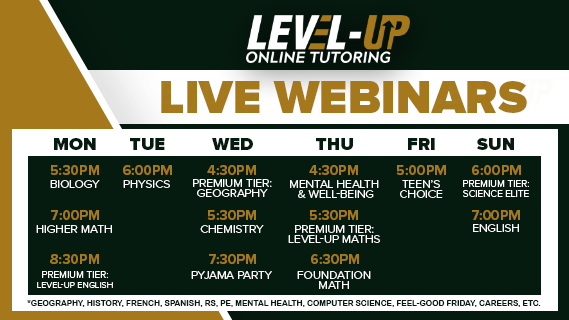
- 32+ live classes a month with experienced, high-performing teachers across the core GCSE subjects.
- Daily access to 15+ expert teachers inside the community for “I’m stuck” questions and homework support – so problems don’t silently build up.
- Weekly mental health and teen hangout sessions to talk about stress, motivation, friendships and confidence in a safe, supportive space.
- On-demand lessons and pre-recorded modules so they can revisit tricky topics whenever they need to, at their own pace.
- A friendly community of 500+ UK students so they realise they’re not the only one finding this hard – which can be a huge relief.
Level-Up is built so that you don’t have to be the teacher, counsellor and project manager all at once. You provide the steady home base; Andy and the team provide the structure, teaching and wellbeing support around your teen.
If you’d like to see how other families have found it, you can read our 5-star reviews here.

With Level-Up, your teen isn’t doing GCSEs alone – they’re surrounded by expert teachers, wellbeing support and a community that gets it.
✅ Want to support GCSE results and mental health at the same time (without lowering standards)?
Bottom line: you don’t have to pick one or the other
Supporting GCSE results and mental health at the same time is not only possible – it’s the most sustainable way forward. Clear expectations, simple routines and the right support system mean your teen can work towards strong grades without feeling crushed by pressure, and you don’t have to carry the whole load on your own.
Mind reading: What actually matters right now for GCSE success?
Also helpful: How to reduce GCSE stress and anxiety for teens