


If you’ve found yourself thinking “my child wont listen to me about GCSE revision” — and every conversation ends in eye-rolling, silence or a full-blown argument — you’re not alone. Most parents care deeply. The problem isn’t effort. It’s that GCSE revision sits right on top of your teen’s biggest triggers: overwhelm, fear of failure, and feeling controlled.
This post gives you a simple, calmer approach you can use straight away — the CALM method — so you can reduce conflict at home, keep expectations steady, and help your teen take ownership (without bribing, threatening or burning out).
Why teens stop “listening” the moment you mention revision
When teens feel pressured, their brain often flips into defence mode. That can look like attitude, avoidance, “I know!” or “Leave me alone!” — but underneath it’s usually one of these:
- Overwhelm: “There’s too much. I don’t know where to start.”
- Fear: “If I try and still do badly, that proves I’m not good enough.”
- Shame: “I’m behind. Everyone else gets it.”
- Control: “This is the one area where I get to decide — so I push back.”
The goal isn’t to “win” the conversation. It’s to help their nervous system feel safe enough to engage again.

If revision talk always ends in conflict, the missing piece is usually the approach — not your parenting.
The CALM method (use this when your child won’t listen)
CALM is a simple 4-step pattern that helps you keep standards and reduce arguments:
C — Connect first (reduce the threat)
Before you talk about revision, connect with their feelings. This doesn’t mean you agree with avoidance — it simply lowers the temperature.
- “I can see you’re stressed. I’m not here to argue.”
- “I get that this feels heavy. Let’s keep it small.”
- “I’m on your side. I want this to feel manageable.”
A — Ask, don’t accuse (invite ownership)
Accusations create defence. Questions create thinking.
- Instead of: “You’ve done nothing.”
- Try: “What feels hardest about starting right now?”
- Instead of: “You never listen to me.”
- Try: “What kind of support would actually help you right now?”
L — Limit the choices (two options only)
Teens often respond better when they keep some control. Give two acceptable options — not an open debate.
- “Do you want to start with Maths or English?”
- “Would you rather do 20 minutes now or 20 minutes after dinner?”
- “Do you want to join a live session or watch a replay?”
This avoids power struggles and still moves them forward.
M — Make the next step tiny (momentum beats motivation)
When your teen is stuck, your best friend is a tiny next step. Not “revise all evening”. Just “start”.
- “Let’s do 10 minutes to get the ball rolling.”
- “Pick one topic and one task — that’s it.”
- “When the timer ends, you can stop or carry on — your choice.”
Once they start, motivation often follows. The hardest part is beginning.
What to say (and what to avoid) when it’s starting to kick off
Use these quick “swap” lines to keep the conversation calmer:
- Swap: “You’re wasting time.”
For: “Let’s choose one small thing to do today — what feels doable?” - Swap: “If you don’t revise, you’ll fail.”
For: “We can’t control results today — but we can control the next 25 minutes.” - Swap: “Why can’t you be more like…?”
For: “I’m interested in your progress — not comparisons. What would help you improve this week?” - Swap: “I’m sick of telling you.”
For: “I’m going to step back from repeating myself. Let’s agree a plan and a check-in.”
The “Weekly Agreement” that stops daily arguments
This is a simple way to keep standards high without you nagging every night.
- Parent chooses: the minimum (e.g. 4 sessions a week).
- Teen chooses: the days/times (so they keep some control).
- Both agree: one weekly check-in (10 minutes).
You can literally say: “I won’t chase you every day. But we do need a minimum each week. You choose when — I’ll support you to stick to it.”
If you’d like a ready-made structure to copy, this post pairs well with: GCSE revision plan for the last few months.
Structure reduces stress — and stress is often what’s blocking motivation in the first place.
When you shouldn’t be the one giving the help
Sometimes the problem isn’t parenting at all — it’s that your teen needs a neutral third party. Especially if:
- They shut down with you but open up with teachers.
- They feel embarrassed getting things wrong in front of family.
- They need faster answers than school can provide.
This is where the right support can take the pressure off home life completely.
How Level-Up helps when your child won’t listen to you
One of the biggest benefits of Level-Up is that it moves revision support away from parent-teen conflict. Instead of you chasing, persuading or explaining, your teen gets structure and guidance from teachers and a community — which often means less arguing and more momentum.
Want to see how Level-Up works before you decide?
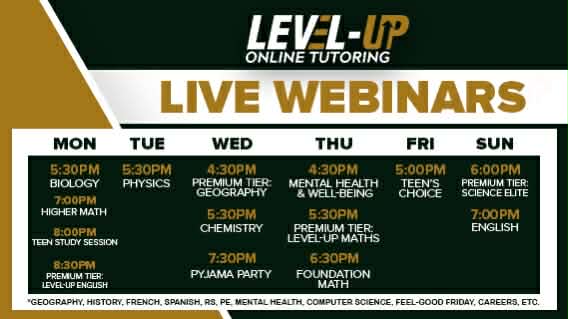
Andy runs a friendly 20–30 minute Welcome Session every Tuesday at 7pm (UK time) for new and curious parents and students. You’ll see how to find the right lessons quickly, how live lessons and replays work, and how the community supports your teen day to day.
Reserve your place for the next Tuesday session
You don’t need to be a member to join – it’s a chance to explore the platform and ask questions before you commit.

Click the image to see Level-Up on Skool — a calm, structured support system that takes pressure off parents.
Inside the Level-Up GCSE Support Community, your teen gets:
- 32+ live classes a month across core GCSE subjects.
- Daily access to 15+ expert teachers inside the community for quick help when they’re stuck.
- Weekly mental health and teen hangout sessions to reduce stress and boost confidence.
- On-demand lessons and modules so they can revisit tricky topics at their own pace.
- A supportive community of UK students for motivation, buddy support and momentum.
And if you’d like to see what other families have said about the experience, you can read our 5-star reviews here.
✅ Want to stop the nightly arguments and get your teen properly supported?
Bottom line
My child wont listen to me about GCSE revision doesn’t mean you’re failing as a parent. It usually means they’re overwhelmed, stuck or trying to protect themselves from stress. Use CALM: connect, ask, limit choices, and make the next step tiny. That approach reduces power struggles — and with the right support around them, your teen can start building real momentum.
Mind reading: How to help with GCSE revision without nagging, backing off or taking over
Also helpful: What actually matters right now for GCSE success?